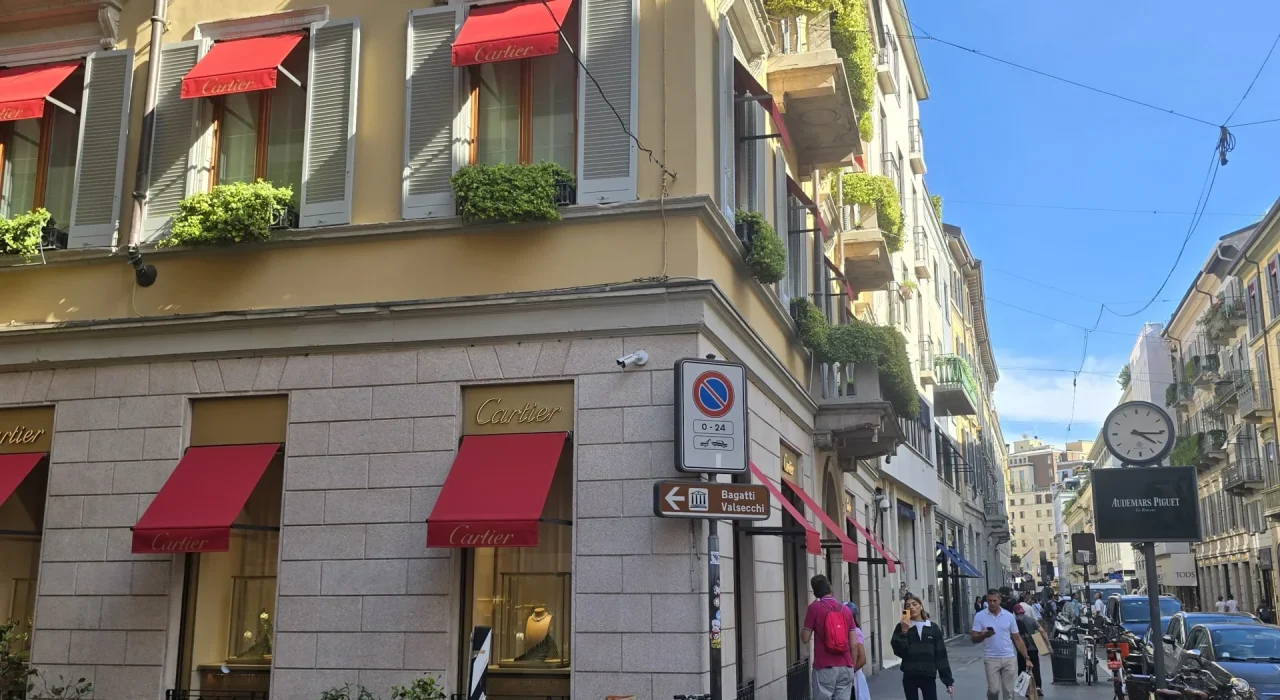
A stroll past the designer windows of Via Montenapoleone Milan, to see what the world’s biggest fashion houses think we should be wearing — or at least contemplating through very expensive glass — right now.
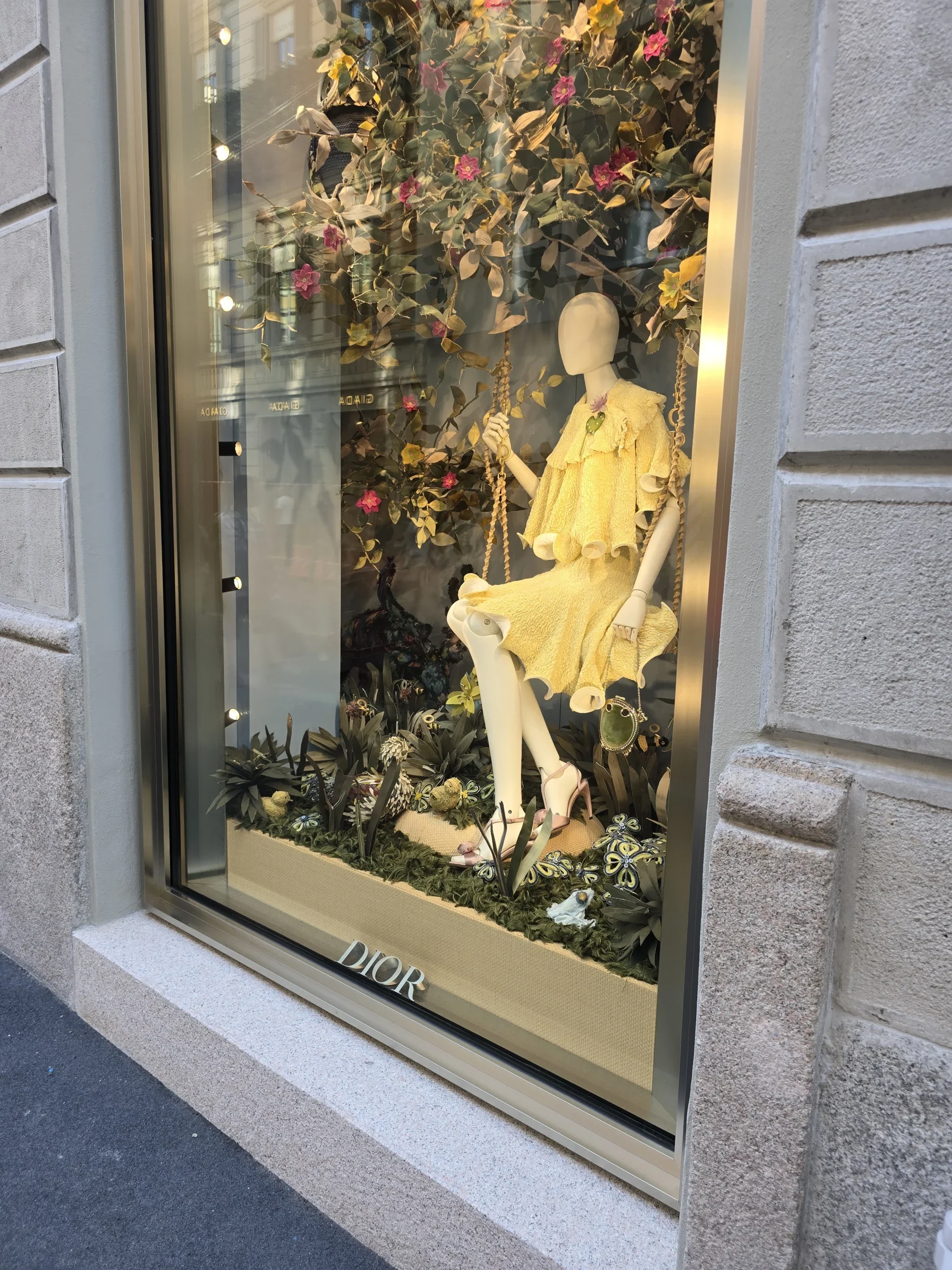
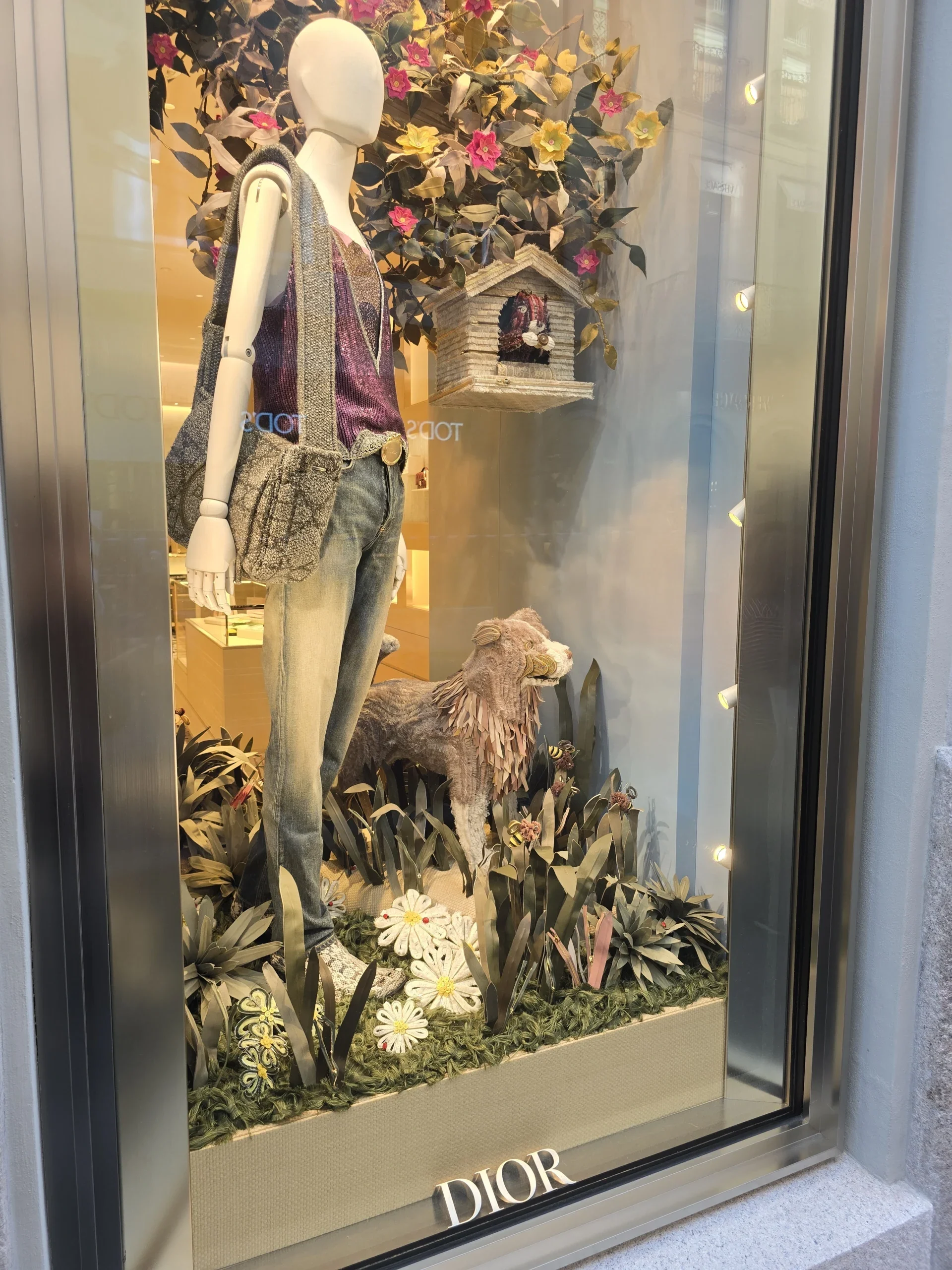
Dior — An Enchanted Garden
At Dior, autumn appears to have been postponed. The windows have been transformed into an extravagant textile garden of trees, oversized flowers, birds, bees and assorted creatures — some of which actually move. The flamingo slowly turns his head, while other animals stir among the foliage. It is all wonderfully theatrical — although the flamingo does appear to be making a determined attempt to upstage the collection.
The setting echoes Jonathan Anderson’s Autumn-Winter 2026–2027 collection, presented in the Jardin des Tuileries and inspired by the idea of a walk through a park becoming a performance. Dior describes the collection as “clothes with the appearance of flowers,” and the Milan windows take the idea quite literally.
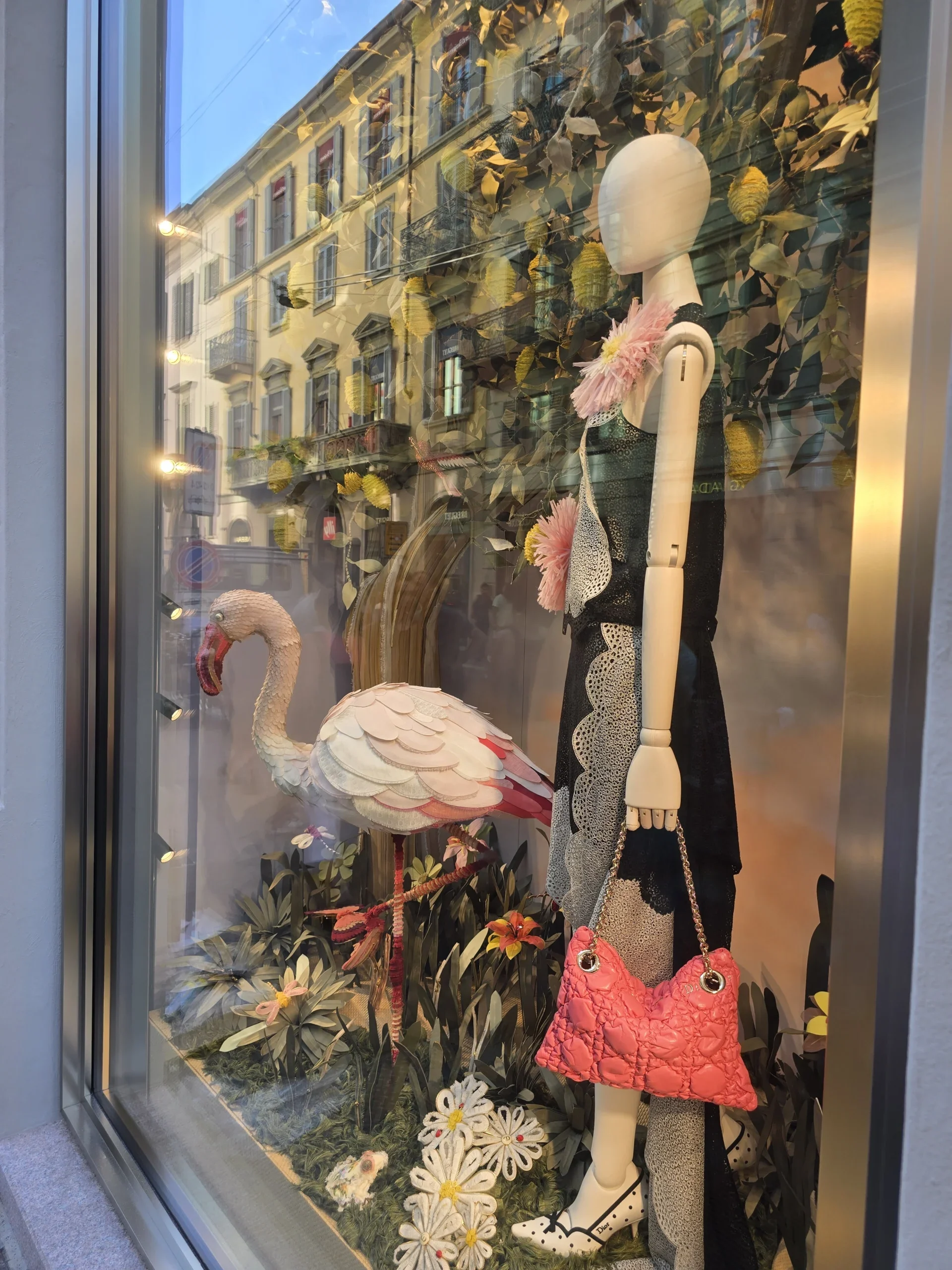
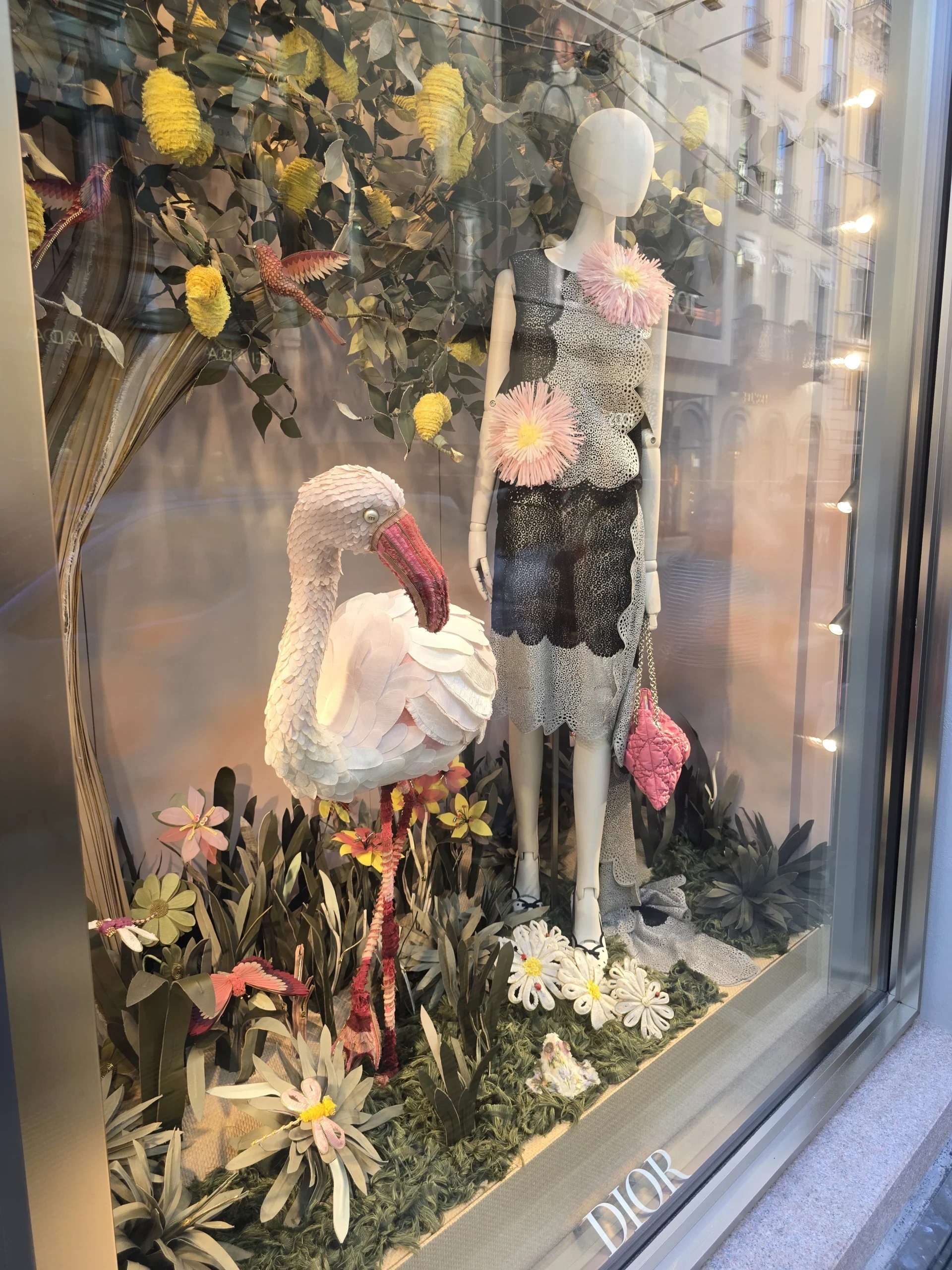
A buttery-yellow skirt and top ripple into extravagant petal-like ruffles; black-and-white dresses are softened by scalloped lace and enormous powder-pink blooms. Elsewhere, faded stonewashed jeans appear with a shimmering top and oversized slouchy bag — very much in keeping with Anderson’s habit of placing the everyday beside the decidedly extraordinary. Denim, sequins, elaborate knits and floral details all feature in the current collection.
The result is romantic, eccentric and just a little surreal: part fashion display, part mechanical fairy tale.
Gucci — A Very Stylish Getaway
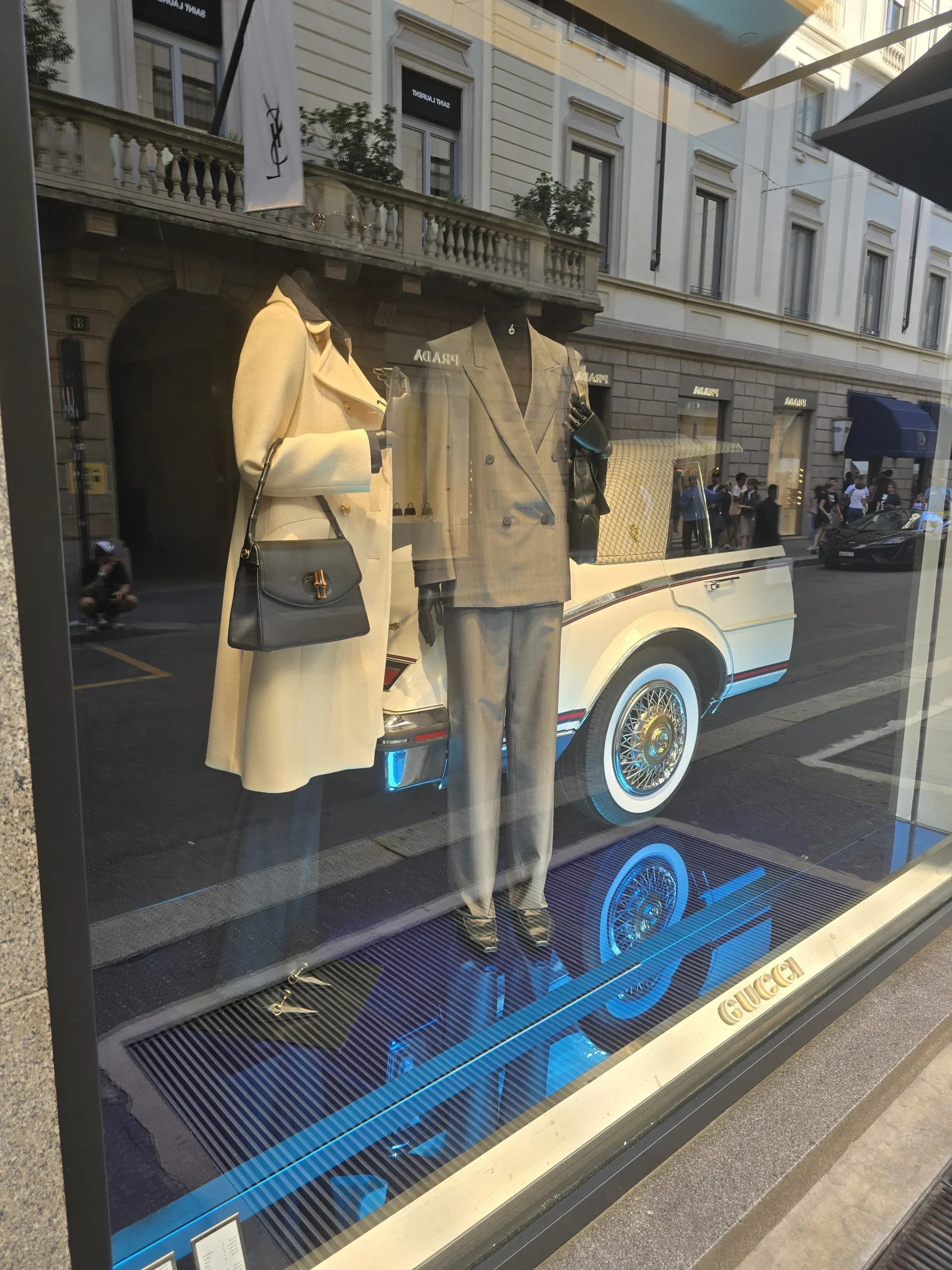
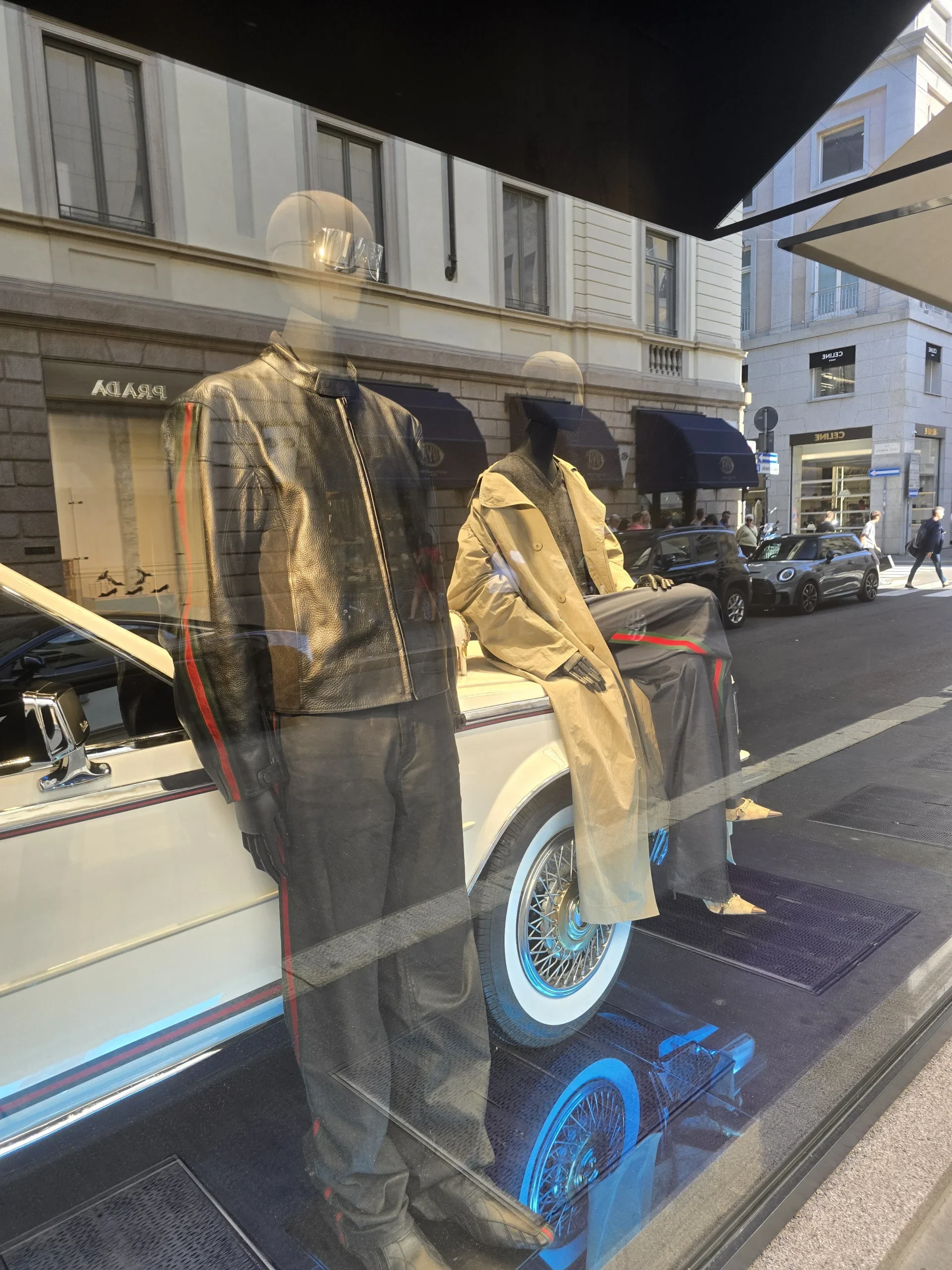
At Gucci, the clothes share the window with something rather harder to fit into a wardrobe: a gleaming vintage car, complete with chrome, whitewall tyres and Gucci’s red-and-green Web stripe running along its side. The mannequins stand — and lounge — around it as though somebody has interrupted them halfway through a particularly stylish departure.
The clothes belong to Demna’s Fall 2026 collection for Gucci, somewhat confusingly called Gucci Primavera. Despite the name, this is not a spring collection: Primavera is the title Demna gave his first full runway collection for the house, drawing on ideas of rebirth as well as Gucci’s Italian cultural heritage.
In the windows, that new Gucci language is rather easier to read. There is a fluid grey double-breasted suit, a long cream coat, a beige trench worn over wide black trousers, and a black leather jacket and trousers sharply marked with the familiar red-and-green Web. Bags and elongated, pointed shoes complete the picture. It is polished, but not particularly restrained — tailoring and classic Gucci codes given a noticeably more contemporary attitude, much as the collection itself moves between fluid suiting, oversized outerwear, leather and body-conscious silhouettes.
And then, of course, there is the car. It turns what could have been a conventional display of coats, suits and handbags into a little scene with an implied before and after. Where are they going? Why are they so well dressed for the journey? And, this being Via Montenapoleone, where on earth do they intend to park?
Hermès: A Rather Extraordinary Caravan
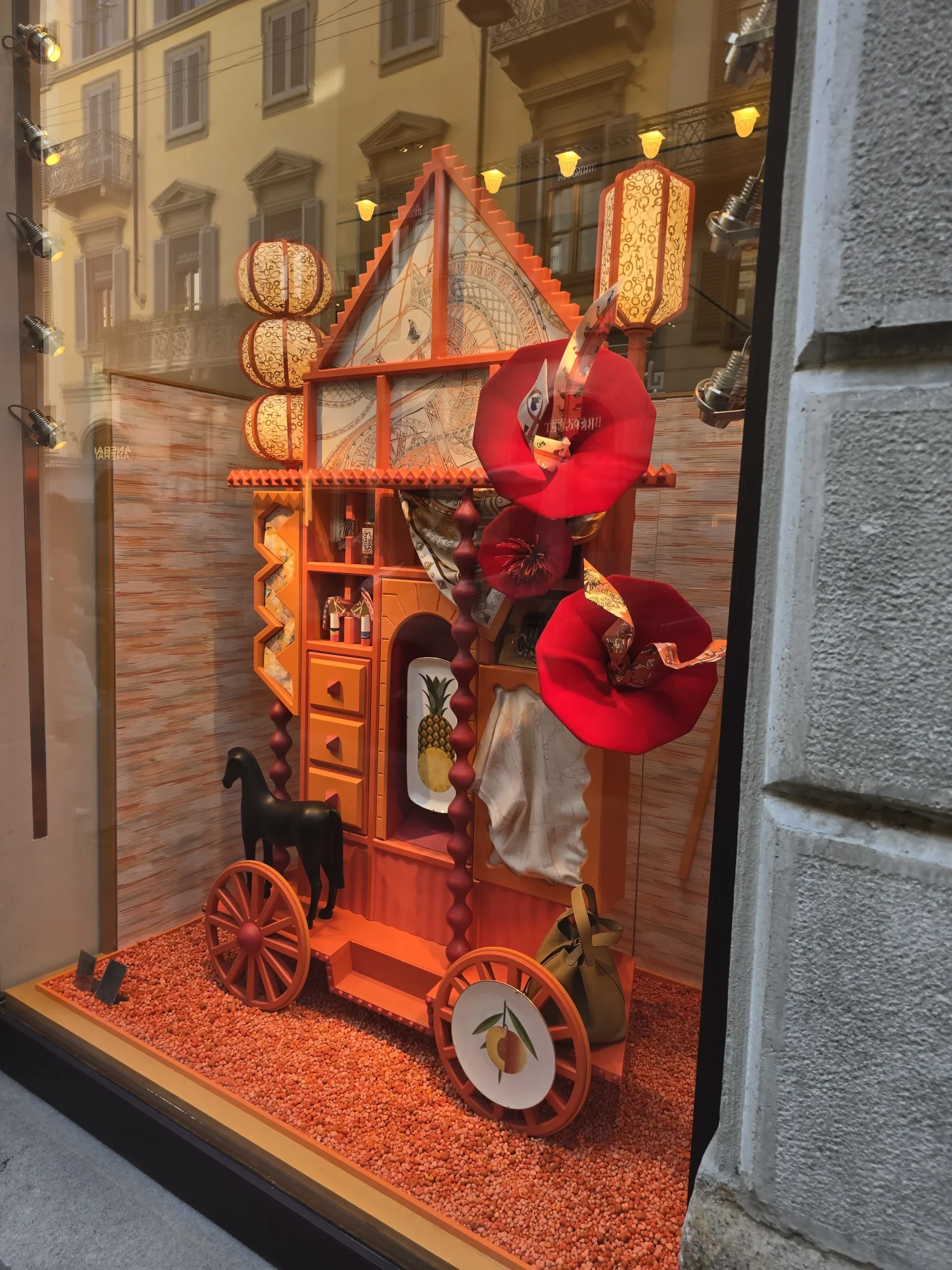
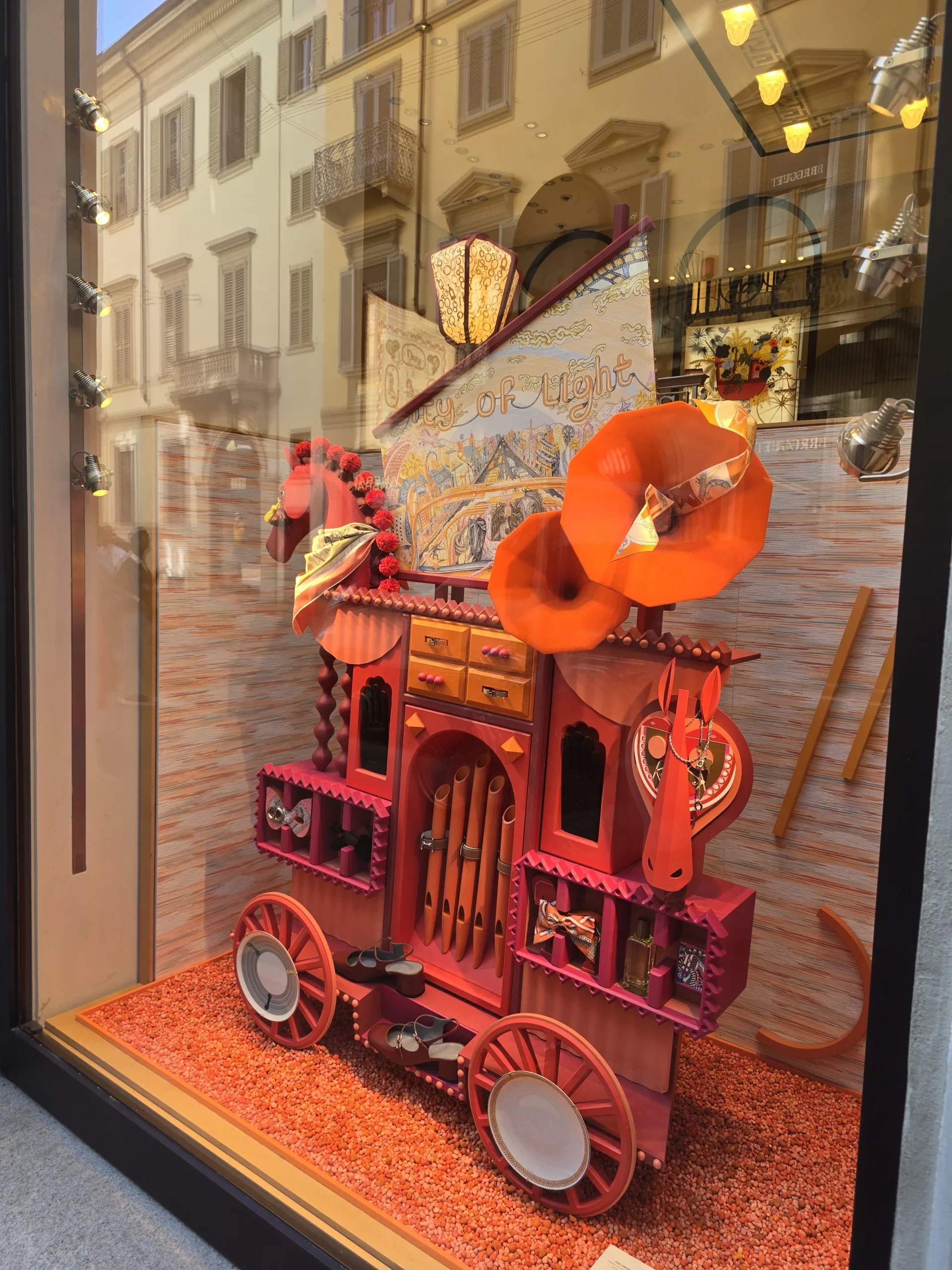
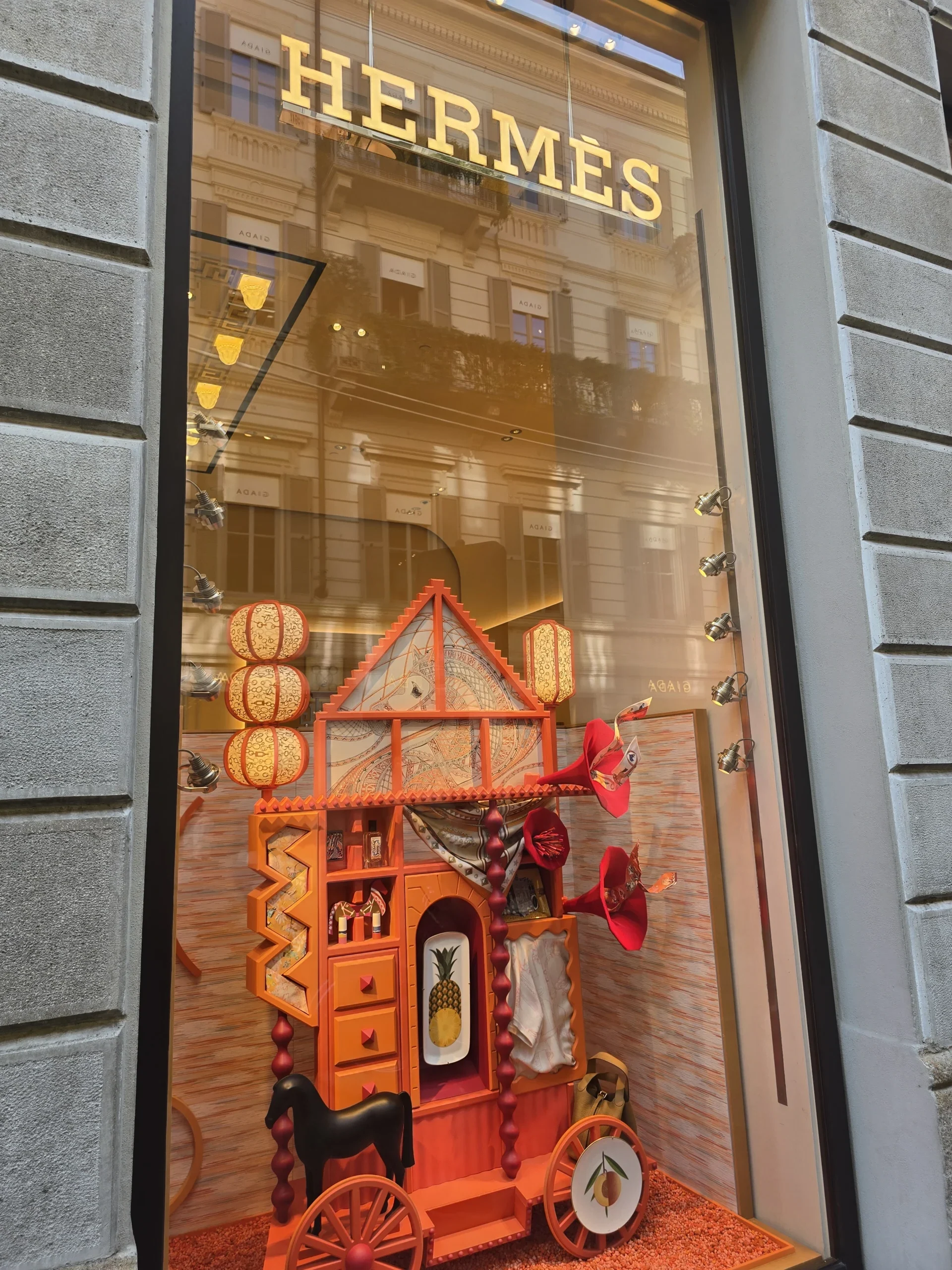
Hermès has turned its Via Montenapoleone windows into a wonderfully eccentric travelling caravan. Tiny architectural façades on wheels are surrounded by glowing lanterns, enormous scarlet flowers and, naturally, horses — although these particular horses seem to have developed a taste for accessories.
Look beyond the spectacle and there is plenty of Hermès hiding in plain sight. Silk scarves are threaded through the displays, tied around the horses and spilling from drawers; belts become harnesses, while shoes, small leather goods, jewellery and bags are tucked into the caravan’s numerous compartments. One horse even carries a beautifully severe black leather bag across its flank. It is a clever way of displaying the things Hermès does particularly well: silk, leather and equestrian references, without lining everything up politely on a shelf.
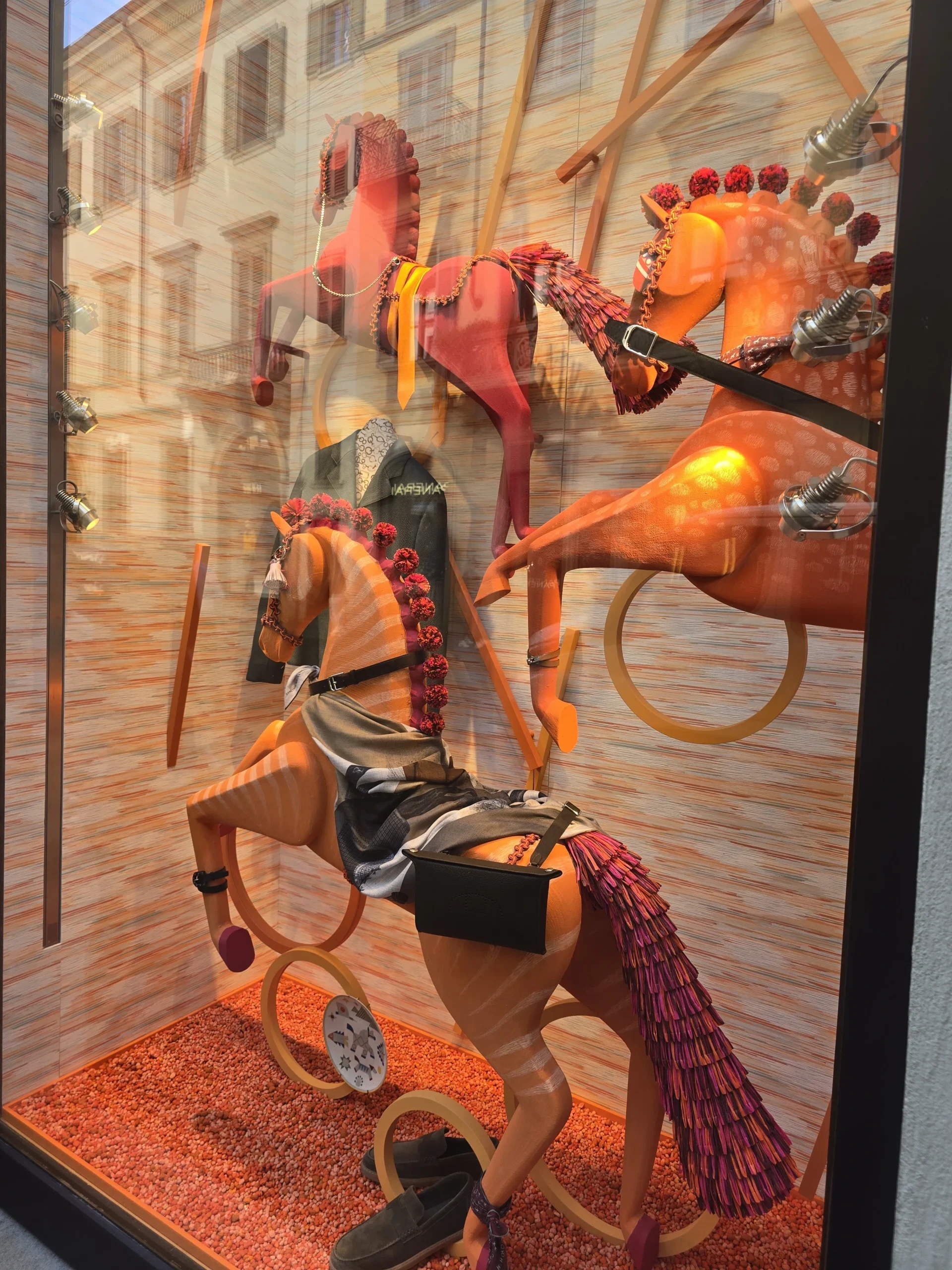
The equestrian theme also makes sense alongside the house’s Autumn-Winter 2026 collection, where Nadège Vanhée returns to Hermès’s horse-riding heritage through pieces including jodhpurs and equestrian-inspired outerwear. The collection itself moves between romance and practicality, with streamlined tailoring, leather, zips and silhouettes designed for movement.
There is so much going on that spotting the merchandise becomes almost a game: a scarf here, a pair of shoes there, another belt disappearing around a horse. At Hermès, apparently, even the horses know how to accessorise.
Prada — What Goes with What?
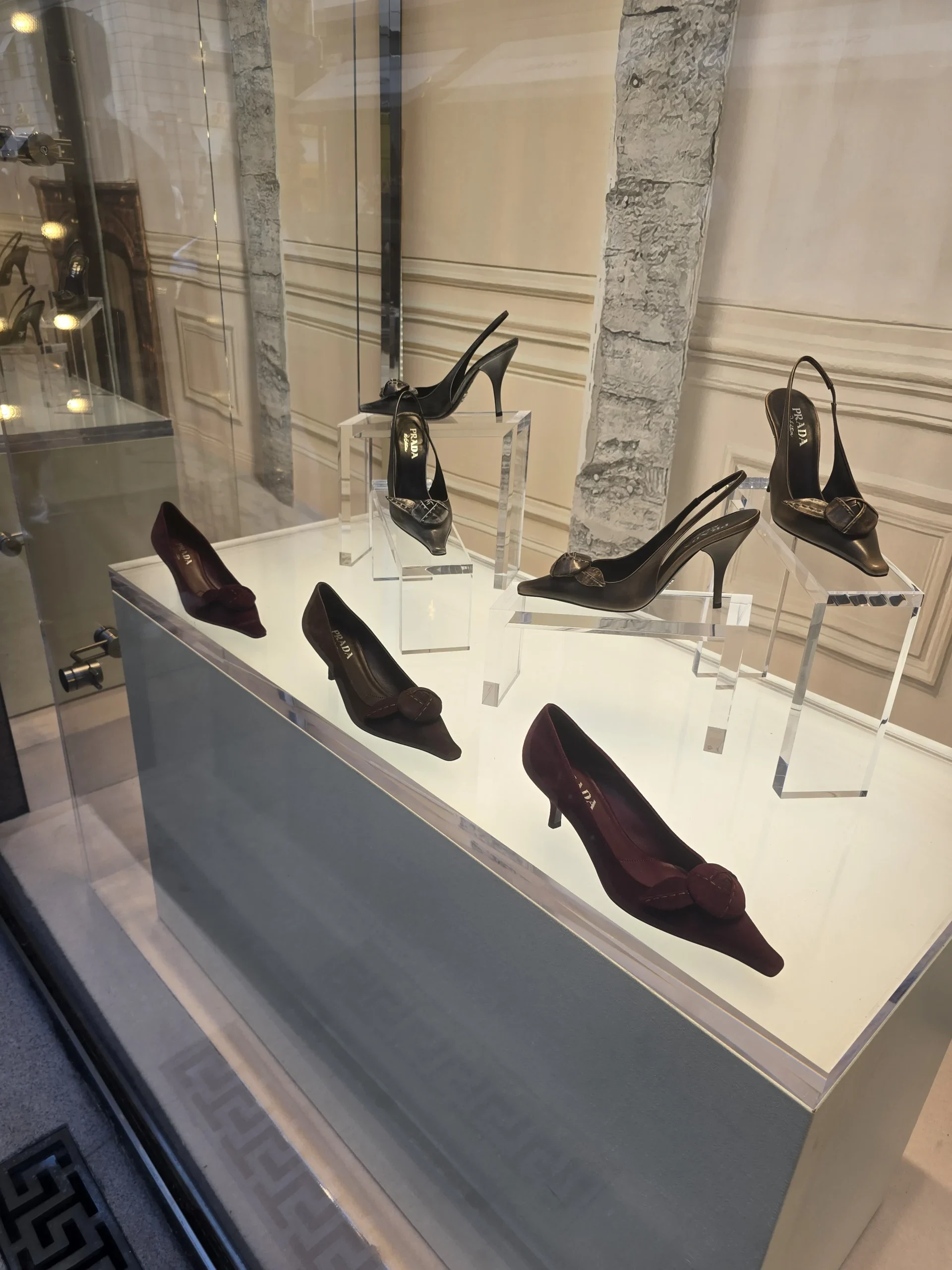
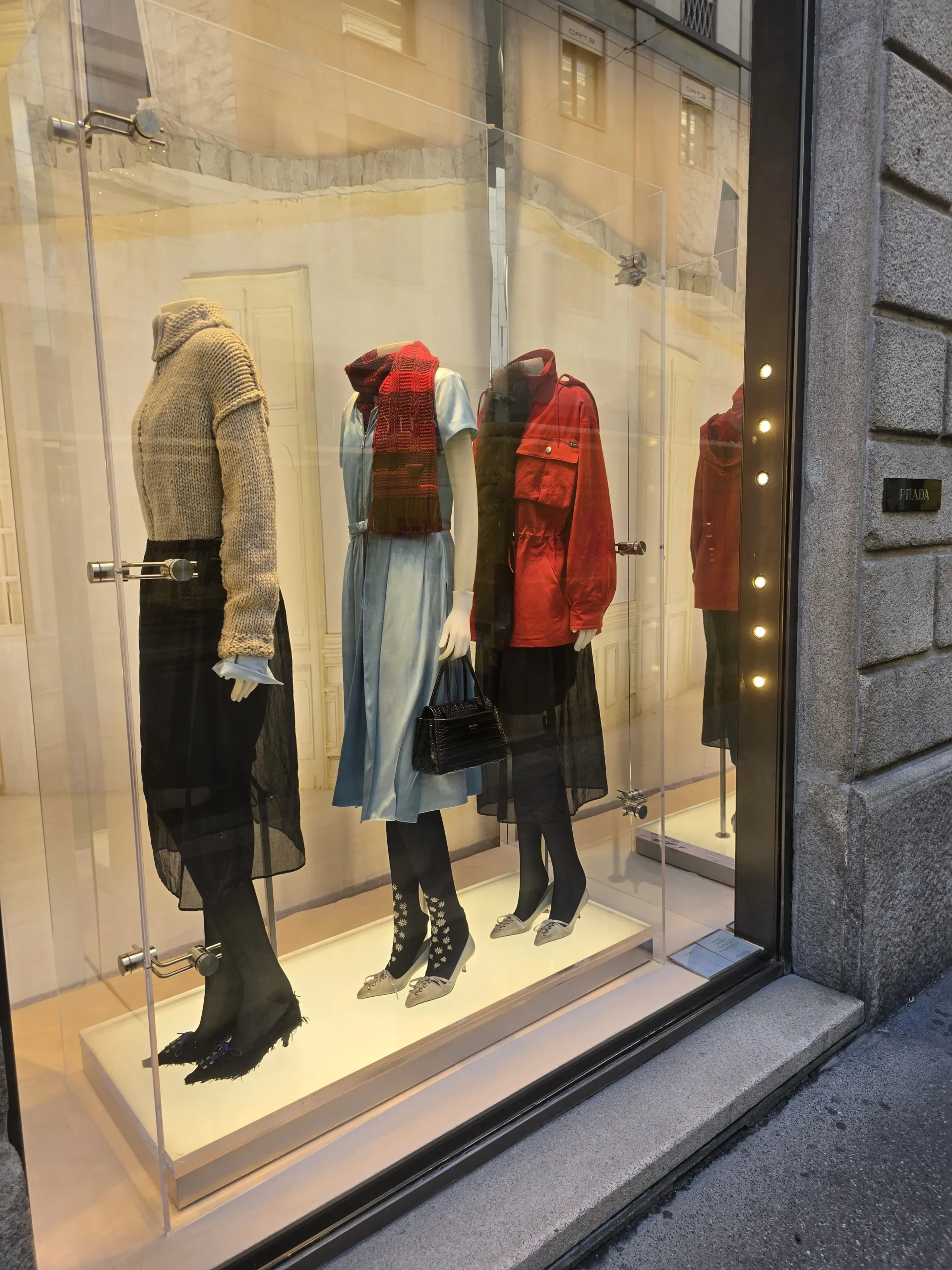
At Prada, the clothes do most of the talking. The windows are relatively simple, with pale architectural backdrops and transparent display stands that leave plenty of room to look closely at what Miuccia Prada and Raf Simons have actually put together.
Their Fall/Winter 2026 collection explores layering and the way women combine clothes — adding, removing and rearranging pieces rather than following a fixed formula. In the window, a pale blue satin dress is worn with a chunky striped scarf and decorated boots; an oversized red utility jacket meets a sheer black skirt; and a substantial oatmeal knit is paired with another long, transparent black layer. Individually familiar pieces become much less predictable once Prada decides what should go with what.
The accessories deserve attention too. A structured black handbag accompanies the blue dress, while pointed footwear is decorated with floral or jewelled details. Another display is devoted to shoes: sharply pointed burgundy pumps and elegant black slingbacks, some finished with prominent leather embellishments. It is all presented with remarkably little fuss, allowing the contrasts in colour, texture and proportion to take centre stage.
Prada makes a persuasive case for looking at your wardrobe differently. Apparently the question is no longer “Does this go with that?” but “Who decided it didn’t?”
Dolce & Gabbana — No Identity Crisis Here
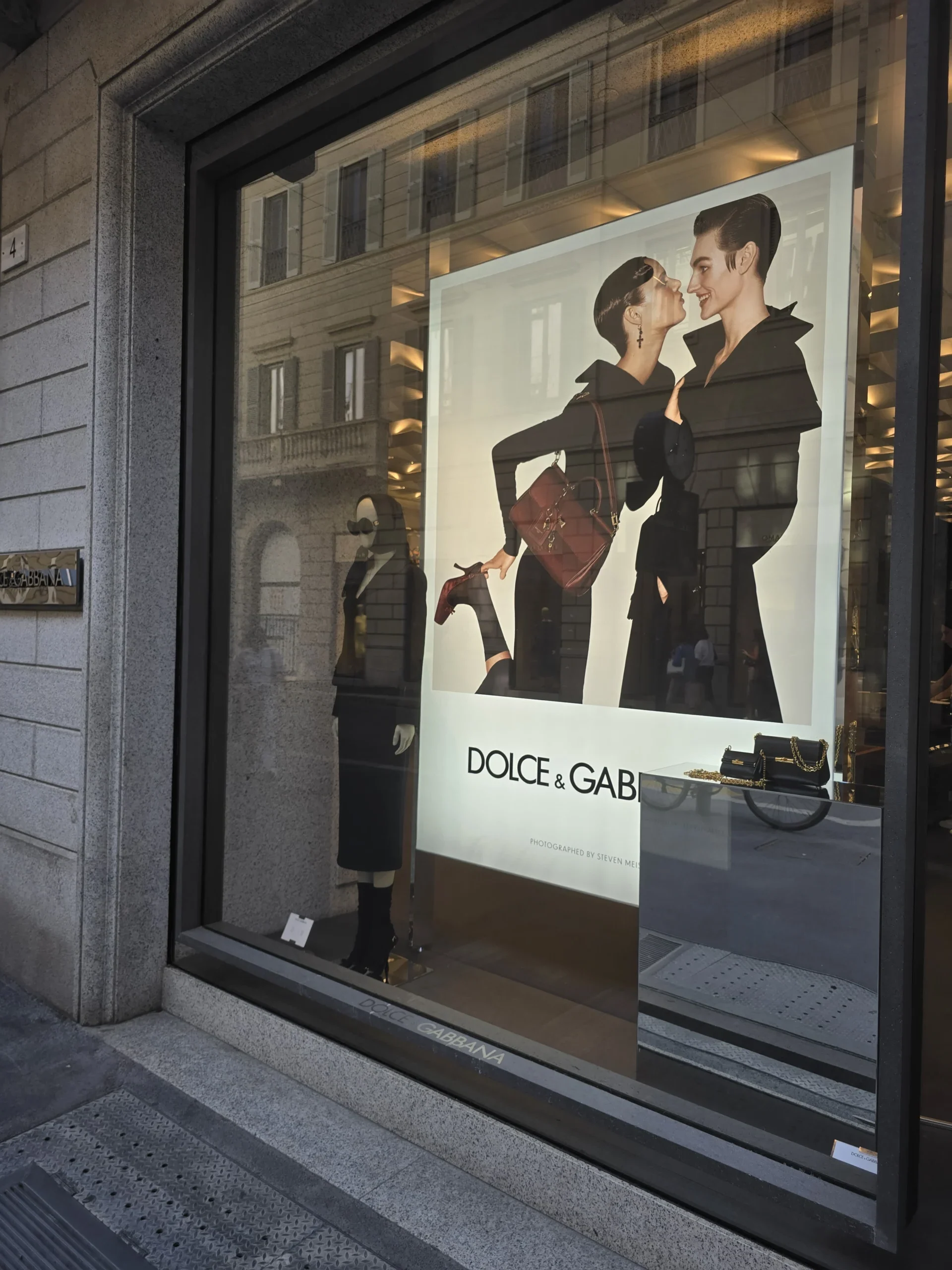
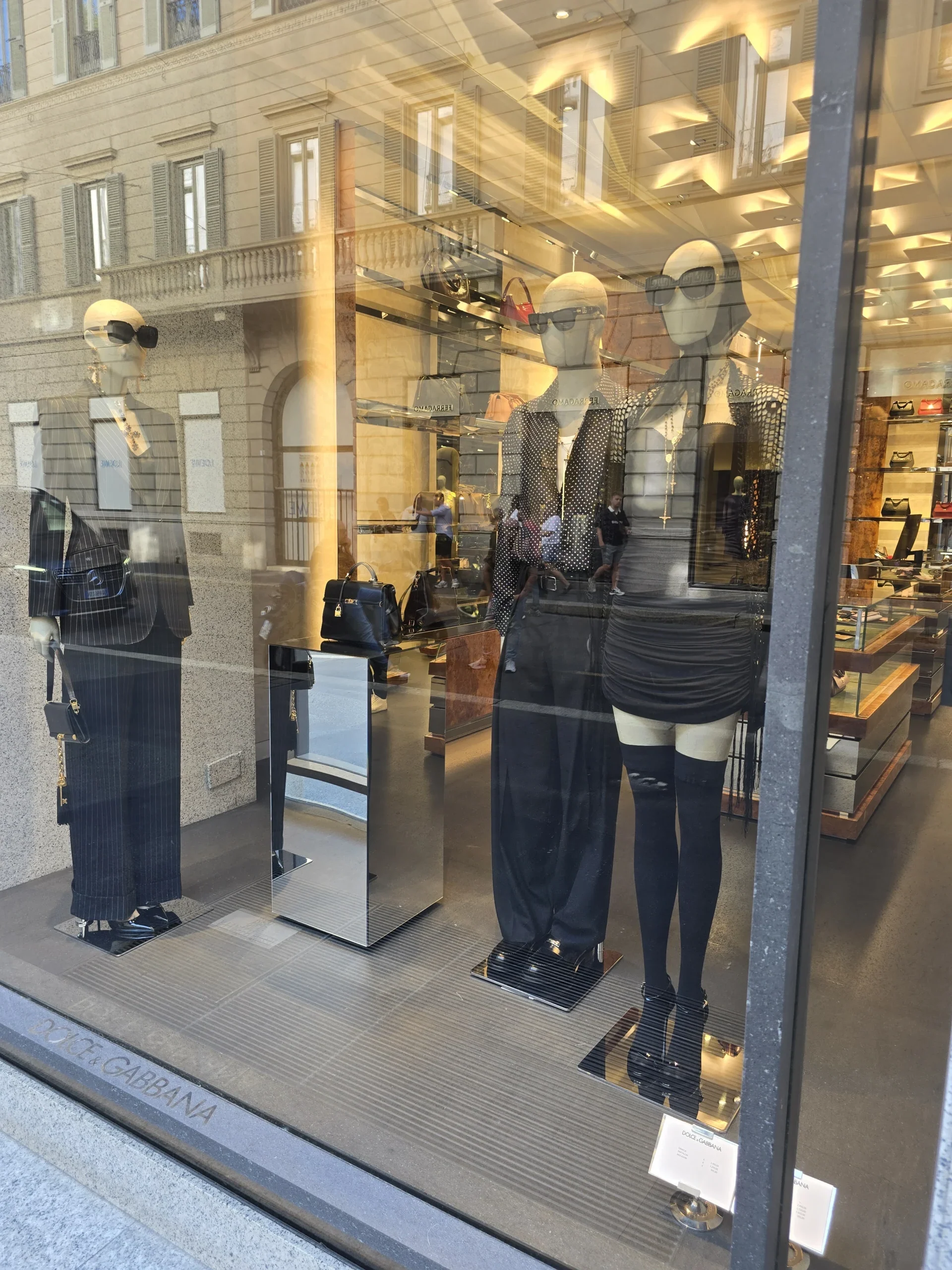
Dolce & Gabbana knows exactly what it wants to be. Its Fall/Winter 2026 collection, “Identity,” is a deliberate return to the house codes Domenico Dolce and Stefano Gabbana have spent decades making instantly recognisable: black, Sicilian influences, lace, sensuality and sharp Italian tailoring.
Those codes are all over the Via Montenapoleone windows. A pinstriped trouser suit borrows confidently from menswear, while another look combines a tiny polka-dot jacket with voluminous black trousers. Beside it, things become considerably less businesslike: a sheer black top and dramatically draped mini skirt are worn with thigh-high stockings, pointed heels and a long cross necklace. Masculine tailoring and overt femininity are not asked to choose sides — which is precisely the conversation running through the collection.
The accessories play along too, with structured black handbags, gold hardware and oversized dark sunglasses. Behind them, Steven Meisel’s enormous Fall/Winter campaign photograph turns the window into something resembling a film poster, its impeccably dressed couple caught in a moment of considerable chemistry. The campaign itself is built around personality, attraction and body language — subtlety, clearly, was not invited.
After forty years, Dolce & Gabbana’s message is remarkably uncomplicated: fashions may change, but knowing exactly who you are has its advantages. Especially when who you are owns this much black lace.
To sum up…
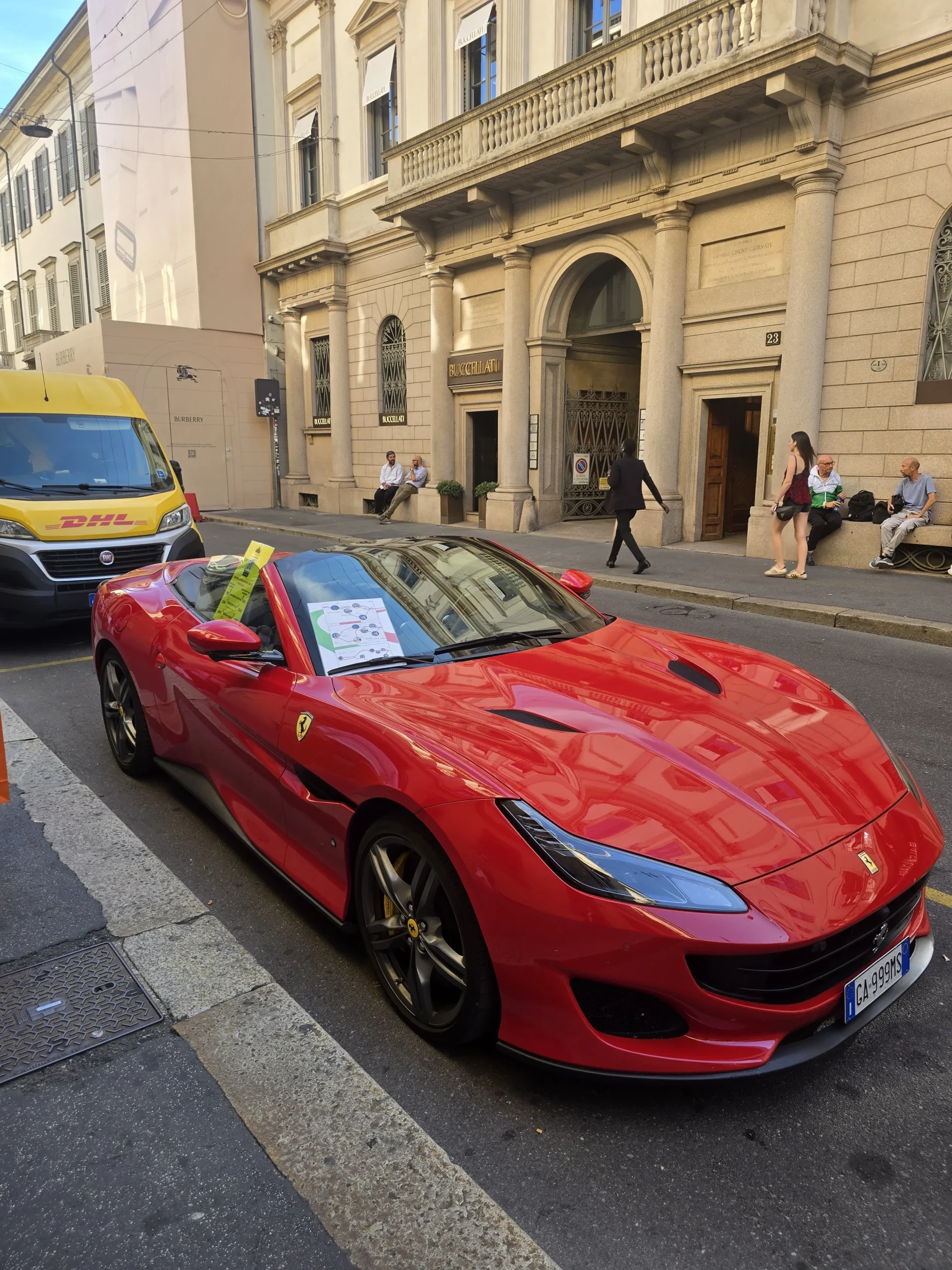
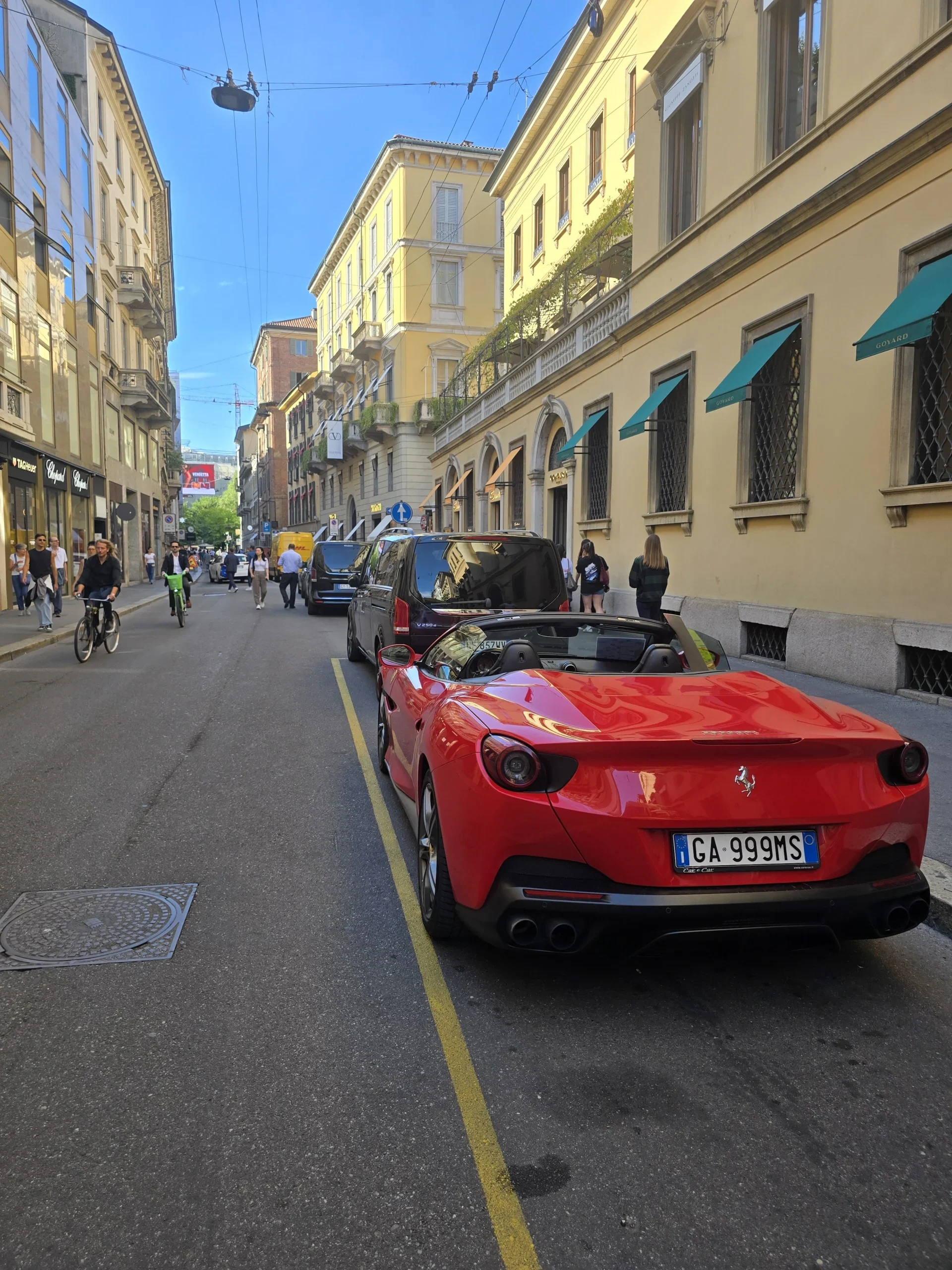
So, this is what we can admire on Via Montenapoleone: fabulous fashion, glamorous boutiques, impeccably put-together Milanese (well, most of the time), and visitors laden with shopping bags from the world’s biggest fashion houses. Plus, naturally, your average Via Montenapoleone runaround. Red, in this case.
If you enjoyed this post, you might also like:
One of the newest Milan fashion brands that’s at once really cool and not overpriced
This post was all about Via Montenapoleone Milan and what’s in the windows of its famous designer boutiques right now.