
Looking for unusual things to see in Milan? Just minutes from the Duomo, Arnaldo Pomodoro’s monumental Grande Disco has a fascinating story — and a surprisingly well-travelled past.
One of the more interesting things to see in Milan isn’t hidden behind a discreet doorway, tucked inside a museum or waiting at the end of a queue.
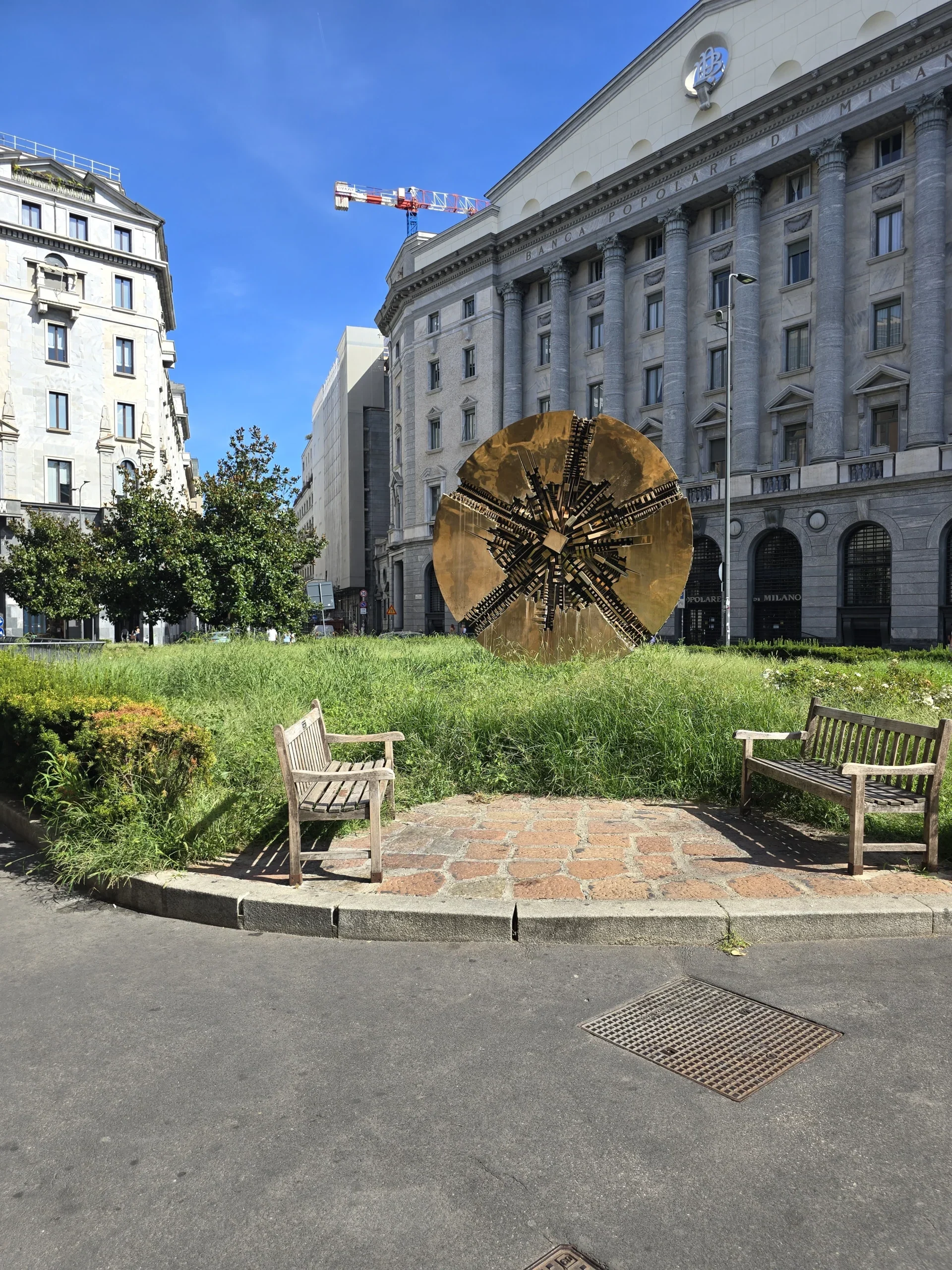
It is sitting in plain sight in Piazza Meda, a few minutes from the Duomo.
And it is very difficult to miss.
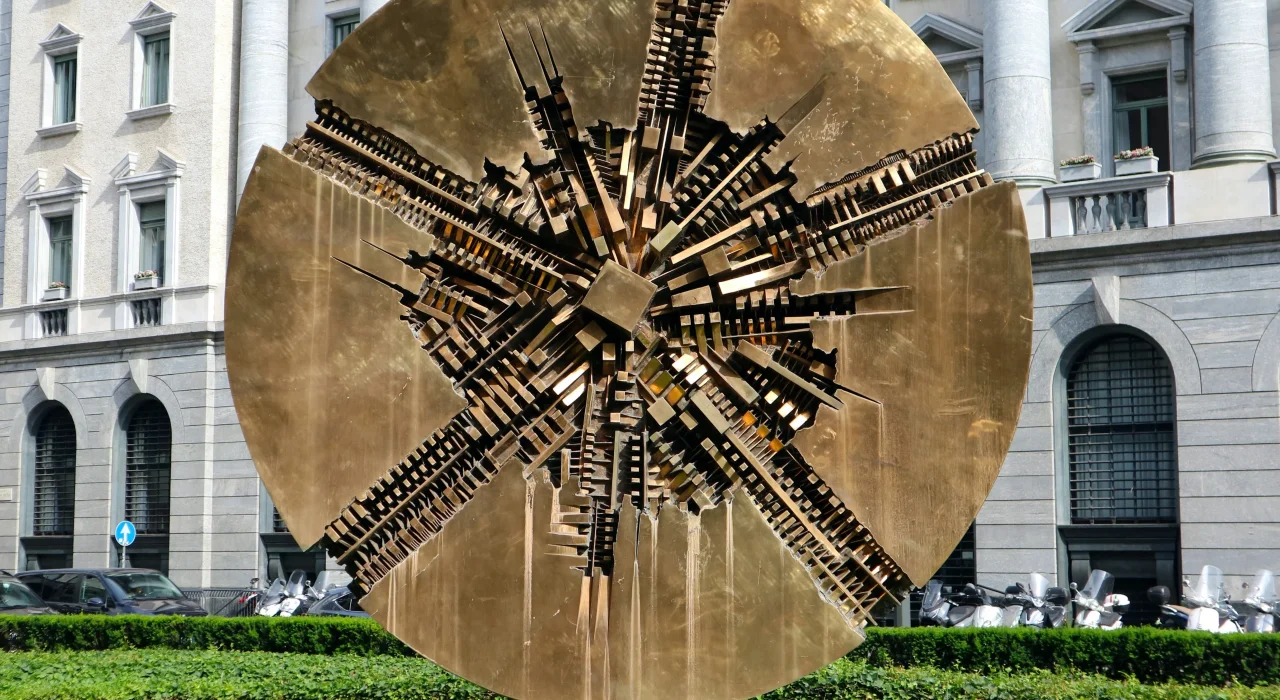
Grande Disco, by Italian sculptor Arnaldo Pomodoro, is an enormous bronze disc measuring 4.5 metres across, standing upright in the middle of the square like some mysterious piece of machinery that has landed in central Milan and decided to stay.
Which, as it happens, isn’t entirely unlike what happened.
Because Grande Disco wasn’t originally intended for Piazza Meda.
A perfect circle that isn’t quite so perfect
From a distance, Grande Disco looks relatively simple: a huge circular form, highly polished and monumental.
Then you get closer.
The smooth surface breaks apart into deep fissures radiating from the centre, revealing geometric forms, ridges and structures that look somewhere between the workings of a machine and the remains of a civilisation whose instruction manual has unfortunately been lost.
This contrast between perfect exterior form and complicated interior structure was central to Pomodoro’s work. He repeatedly took simple geometric shapes — spheres, columns, discs — and broke into them to reveal intricate internal worlds.
From one angle, Grande Disco catches the light and looks almost immaculate. Move a few steps and suddenly you are staring into its entrails.
Contemporary art does occasionally reward walking around it.
So who was Arnaldo Pomodoro?
Arnaldo Pomodoro was one of Italy’s most important contemporary sculptors, famous for monumental bronze works in which smooth geometric forms are split open to expose complex interiors.
His sculptures can be found around the world, but Milan was very much his city.
Born in Romagna in 1926, Pomodoro moved to Milan in 1954 and lived and worked here for the rest of his life. He died at his home in Milan in June 2025, just hours before his 99th birthday.
Grande Disco has now stood in Piazza Meda for more than four decades, looking as though it was always meant to be here.
It wasn’t.
Before Milan, there was Vigevano
Here comes my favourite part of the story.
Grande Disco dates from 1972, but the artist’s proof that eventually came to Milan was first installed in Piazza Ducale in Vigevano in 1976.
If you know Piazza Ducale, you may already see the problem.
It is one of Lombardy’s great Renaissance squares: elegant arcades, painted façades, harmonious proportions and several centuries of architectural history behaving themselves beautifully.
Into the middle of this arrived a gigantic fractured bronze disc.
Opinions were expressed.
The sculpture was considered by many too modern for its surroundings, and its installation caused considerable controversy. Vigevano ultimately did not accept the work as a permanent donation.
Milan, however, was interested.
Carlo Tognoli, then mayor of Milan, wanted the sculpture to remain in Italy, and in 1980 Grande Disco arrived in Piazza Meda.
Vigevano’s loss, as they say.
Although I suspect a few Vigevanesi at the time would have regarded that sentence rather differently.
Why does Grande Disco look like that?
There is something very Pomodoro about taking one of the simplest shapes imaginable and making it deeply complicated.
Five main lines cut outwards from the centre, breaking the polished bronze and exposing the dense structures beneath. The composition has been linked to the proportions of Leonardo da Vinci’s Vitruvian Man, with the human figure contained within the geometry of a circle.
In Milan, that reference feels particularly at home.
But you don’t need to know anything about Leonardo, geometry or twentieth-century sculpture to find Grande Disco interesting.
You can think about machines, cities, technology or the contrast between an orderly exterior and everything complicated happening underneath.
Or you can simply stand there and think: that is an extremely impressive piece of bronze.
Both approaches are permitted.
Look at it properly
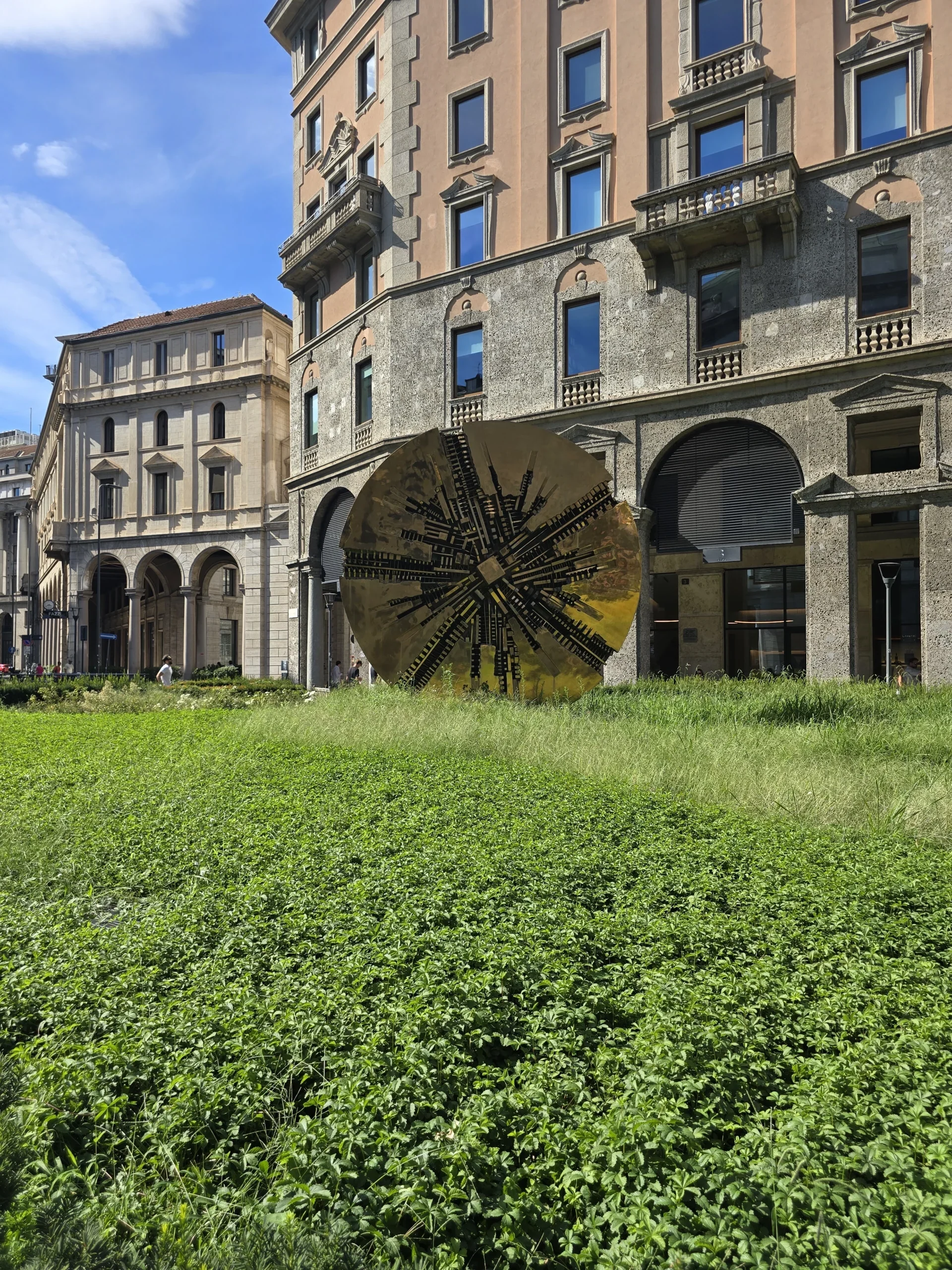
Grande Disco changes considerably with the light. The polished bronze reflects its surroundings while the deep cuts create areas of shadow, making the sculpture look different as you move around it.
And you really should move around it.
Don’t look at it from the pavement, decide you have understood contemporary sculpture and march off towards the Duomo.
Go closer.
Look through the openings. Walk behind it. Notice the tiny architectural and mechanical-looking forms buried inside the enormous simple shape.
Pomodoro was interested in the relationship between sculpture and the space surrounding it, and Grande Disco makes much more sense when you experience it as an object sitting in the city rather than something to be viewed politely from one approved position.
One of the easiest things to see in Milan
There is another considerable advantage to Grande Disco.
No ticket. No booking. No opening hours.
It is simply there.
Piazza Meda is in the historic centre, only a short walk from the Duomo, Piazza della Scala and the Fashion District, so Grande Disco is extremely easy to include while exploring central Milan.
Give it ten minutes rather than ten seconds. Start at a distance, then get close enough to inspect the fissures and internal structures. Walk around to the other side and watch what happens to the bronze as the light changes.
To sum up…
Milan has no shortage of famous things to see, but sometimes the objects that make a city interesting are the ones you could very easily walk straight past.
Grande Disco has been sitting in Piazza Meda since 1980: enormous, fractured, gleaming and slightly mysterious, just a few minutes from one of the most visited squares in Italy.
So next time you’re near the Duomo, make the detour.
You may discover that one of the more unusual things to see in Milan has been hiding in plain sight all along.
If you enjoyed this post, you might also like:
Villa Necchi Campiglio Milan: Where 1930s Milan Got Fabulous
This post was all about things to see in Milan — and the fascinating story behind Arnaldo Pomodoro’s Grande Disco in Piazza Meda.
Cover photo: Frank Eiffert (Unsplash)