
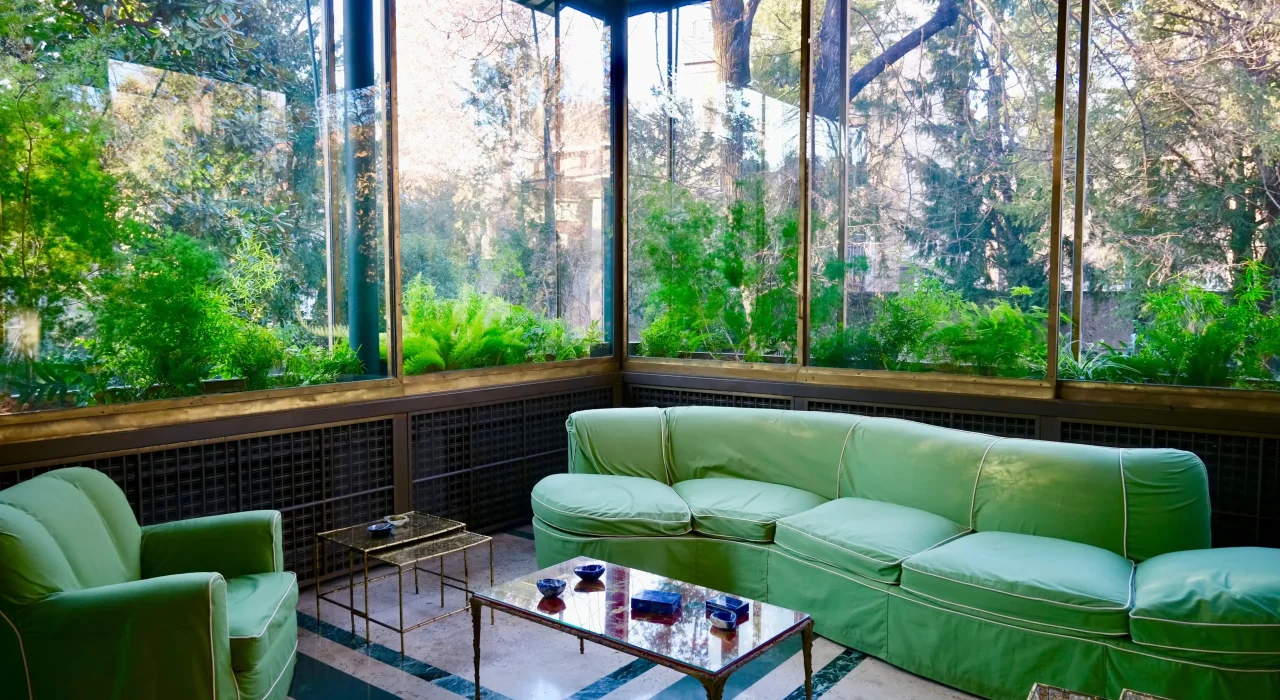
Villa Necchi Campiglio Milan is part architectural masterpiece, part time capsule, and part lesson in how the Milanese did quiet luxury long before quiet luxury became a hashtag.
Hidden behind a discreet gate on Via Mozart, a short walk from the fashion district, Villa Necchi Campiglio is one of those wonderfully Milanese places that manages to be spectacular without shouting about it. No enormous sign. No grand piazza announcing its existence. Just trees, a gate and, beyond them, one of the most beautiful houses in the city. Very Milan.
And if you’ve ever wondered what life looked like for Milan’s extremely well-heeled industrial bourgeoisie in the 1930s, the answer apparently involved exquisite marble, excellent design and being able to go downstairs for a swim without encountering the general public.
Let’s have a look.
First things first: who were the Necchi Campiglios?
The story begins with two sisters, Nedda and Gigina Necchi, and Gigina’s husband, Angelo Campiglio.
The Necchi family had made its fortune in industry in Pavia, and in the early 1930s the trio decided that they needed a home in Milan. Not an apartment. Not even a palazzo. A thoroughly modern villa, surrounded by its own garden, right in the centre of the city. As one does.
They commissioned one of the most interesting Milanese architects of the period, Piero Portaluppi, to design their new home.
Portaluppi worked on the villa in the early 1930s, with the building completed in 1935, and the result tells you quite a lot about both architect and clients.
This wasn’t old aristocratic Milan, all frescoes, ancestral portraits and furniture nobody was allowed to sit on. This was the new Milanese industrial bourgeoisie. Modern. Confident. Technologically enthusiastic. And very, very stylish.
If you’re interested in Milanese architecture, remember the name Piero Portaluppi because once you start noticing his work around Milan, he has an annoying habit of appearing everywhere.
At Villa Necchi Campiglio, Portaluppi wasn’t simply asked to draw four walls and leave the decorators to it.
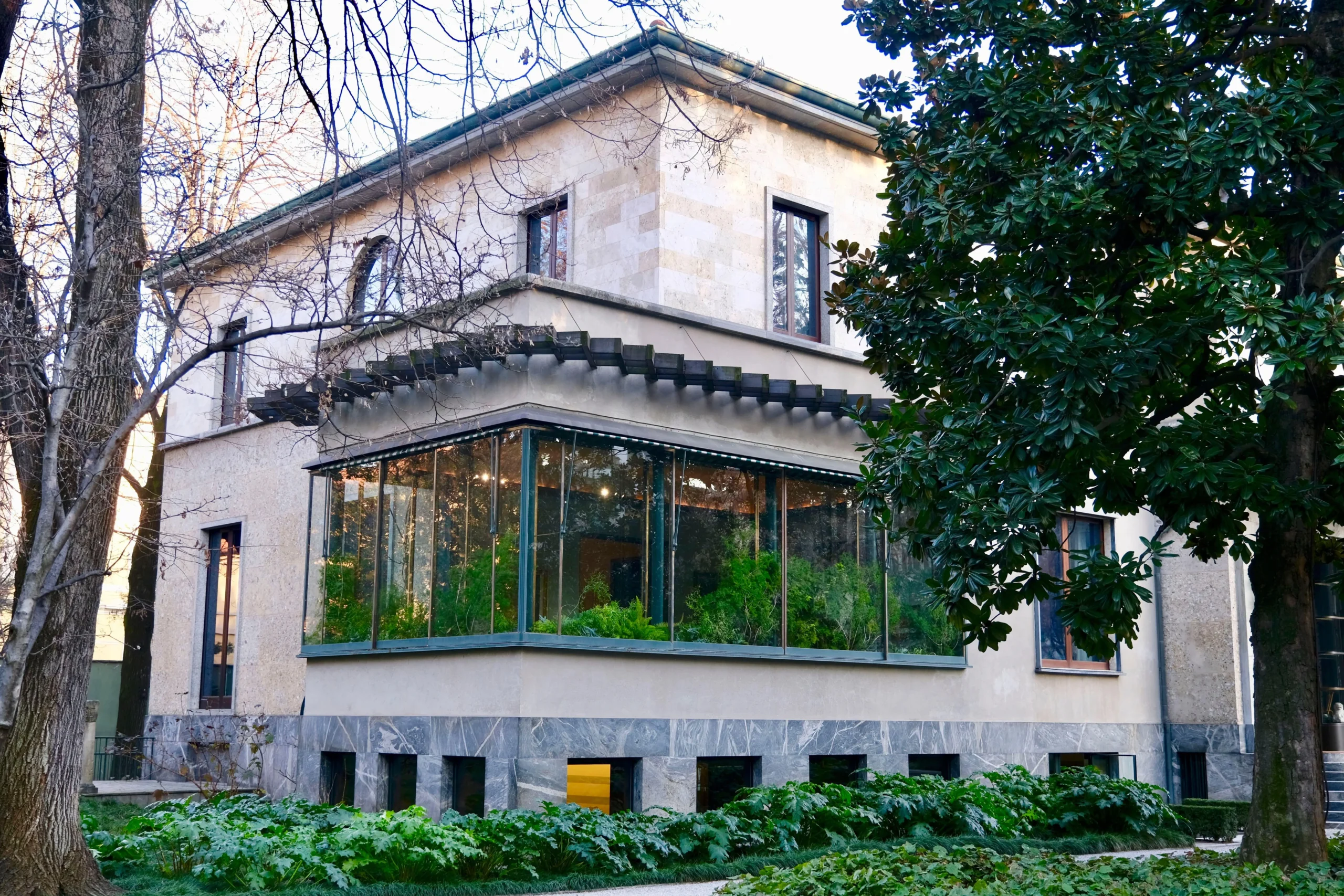
He designed the house as an extraordinarily coherent whole, paying meticulous attention not only to its architecture but to its finishes, furnishings and technological details.
The result is elegant but not fussy.
There are beautiful woods, marble and other luxurious materials. Strong geometries. Huge windows. Clever sightlines between rooms. Spaces designed for entertaining and spaces designed for retreating from all that exhausting entertaining.
Because apparently being fabulously wealthy also requires recovery time.
The layout itself was relatively traditional: reception and living rooms downstairs, bedrooms upstairs, with service spaces tucked into other parts of the house. But the way the villa functioned was strikingly modern. There was an internal lift. There were sophisticated window systems, a separate gatehouse and even a service tunnel.
Portaluppi also designed bespoke furnishings for the house, making the architecture, interiors and technology feel like parts of the same project.
And outside…
Well.
Outside is where things get serious.
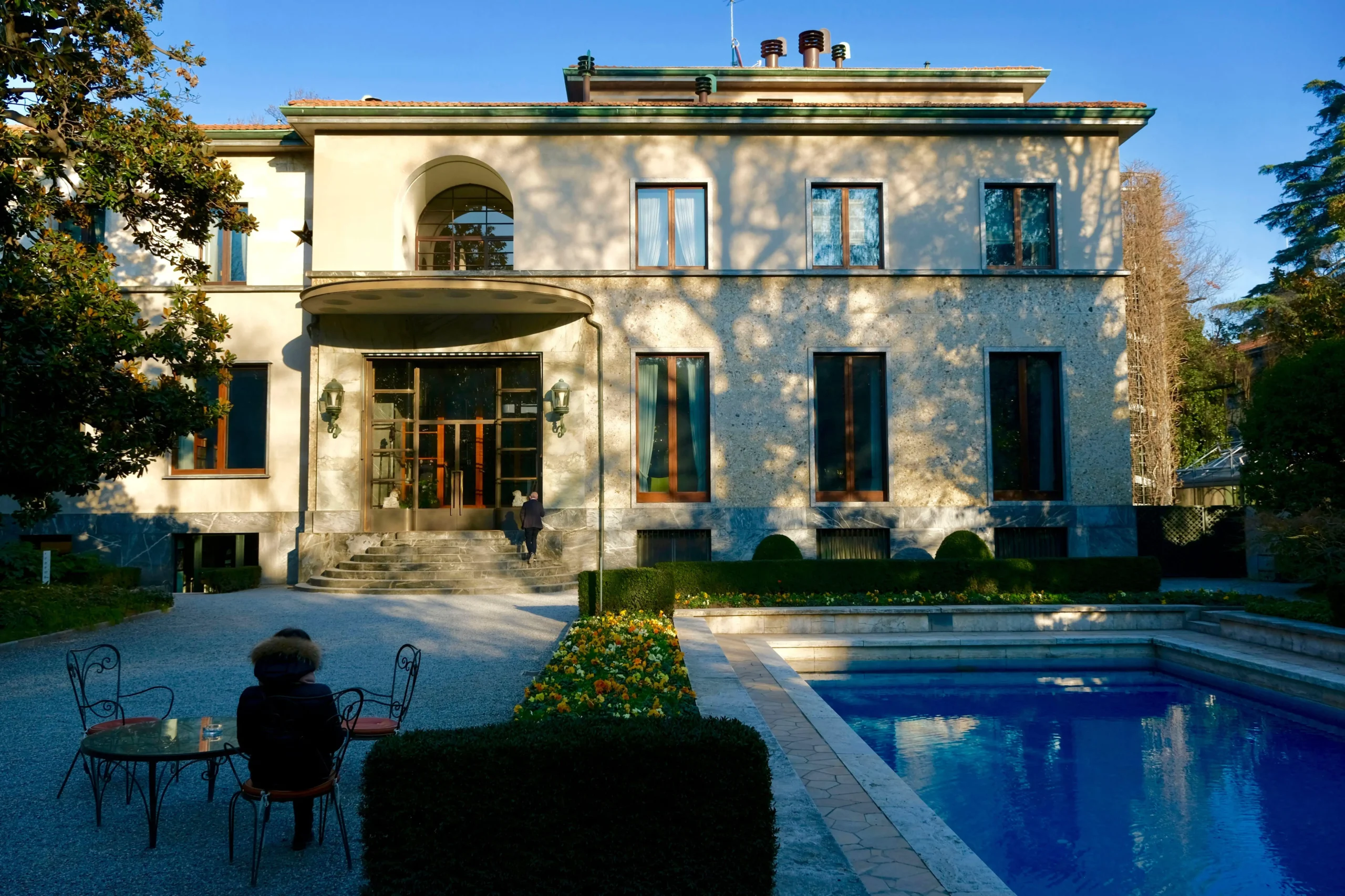
Yes, that swimming pool
Let’s discuss the pool.
Because everyone who visits Villa Necchi Campiglio eventually develops feelings about the pool.
Set into the garden beside the house, surrounded by lawn and elegant landscaping, it looks less like something in central Milan and more like the location where someone in a 1930s film would sip a cocktail while waiting for an inheritance.
And it wasn’t merely a swimming pool. It was Italy’s first private heated swimming pool. In 1935.
Nearby was a private tennis court, completing a picture of modern outdoor living that must have seemed extraordinarily glamorous at the time.
Portaluppi treated the pool as an integral part of the architecture and garden rather than an accessory plonked beside the house. The whole thing feels startlingly contemporary.
You could photograph that pool for an interiors magazine tomorrow and nobody would question it. Which, I think, is part of Villa Necchi’s magic. More than ninety years later, surprisingly little about it feels old.
And then they decided it was too modern
Here comes one of my favourite parts of the story.
Imagine commissioning one of Milan’s most brilliant modern architects to create your cutting-edge dream home. You move in. You admire the clean lines. You enjoy your heated pool.
And then, a few years later, you apparently think: Hmm. Could we make it a little less modern?
In 1938, the Necchi Campiglios commissioned another architect, Tomaso Buzzi, to rethink some of the interiors, beginning a transformation that would become particularly evident in the postwar period.
Buzzi softened some of Portaluppi’s rigorous geometric modernism with a more traditional, aristocratic vocabulary: neoclassical touches, tapestries and furnishings inspired by eighteenth-century style, particularly Louis XV.
Purists may wince. I find it fascinating: because Villa Necchi isn’t a frozen architectural manifesto; it was somebody’s home. Tastes changed. The people living there changed things. Exactly as people do.
And that makes it infinitely more interesting.
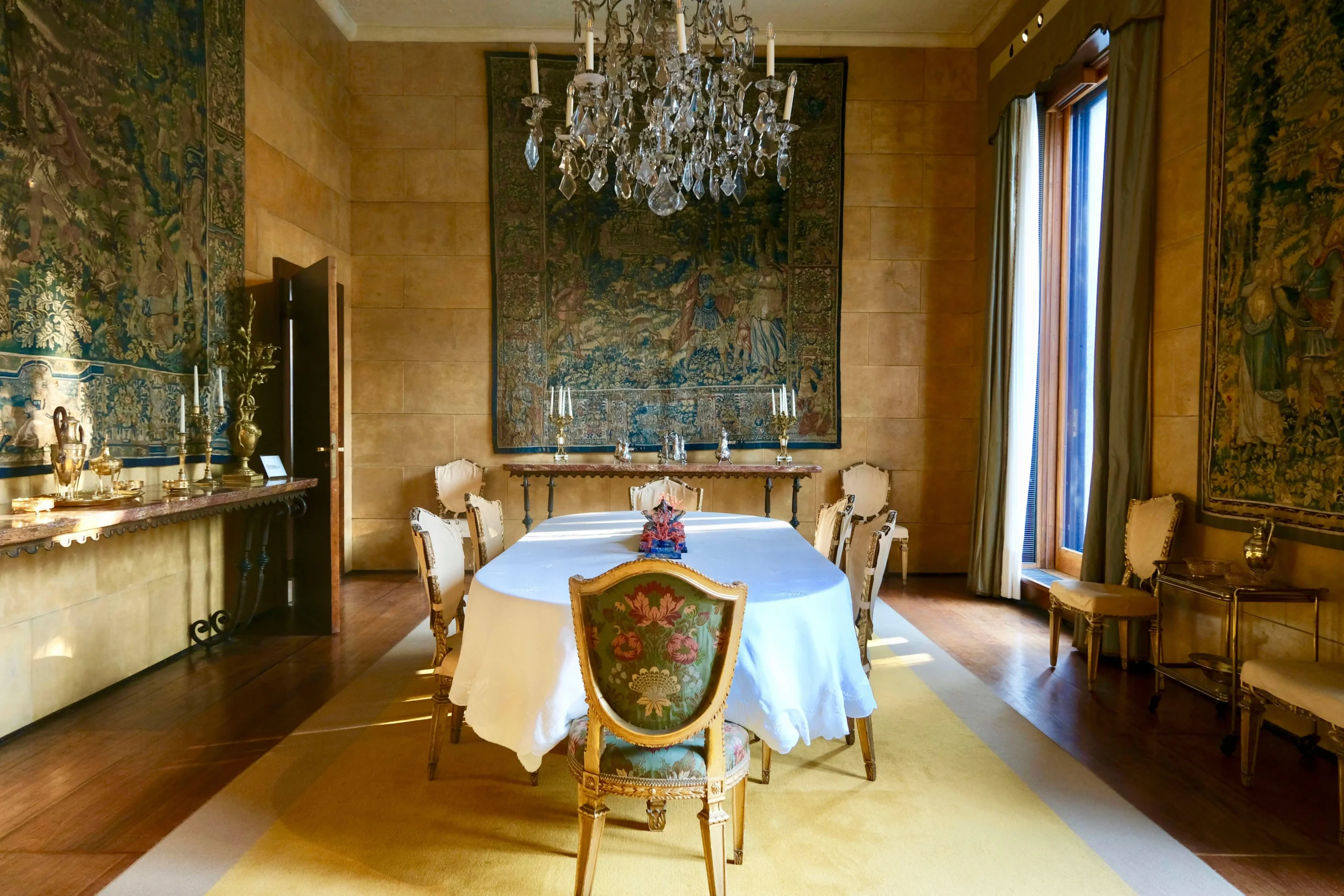
The best part? It still feels like somebody lives here
This, for me, is what separates Villa Necchi Campiglio from many historic houses. It doesn’t quite feel like a museum.
You don’t simply walk from Room Containing Important Chair to Room Containing Important Painting while dutifully reading labels.
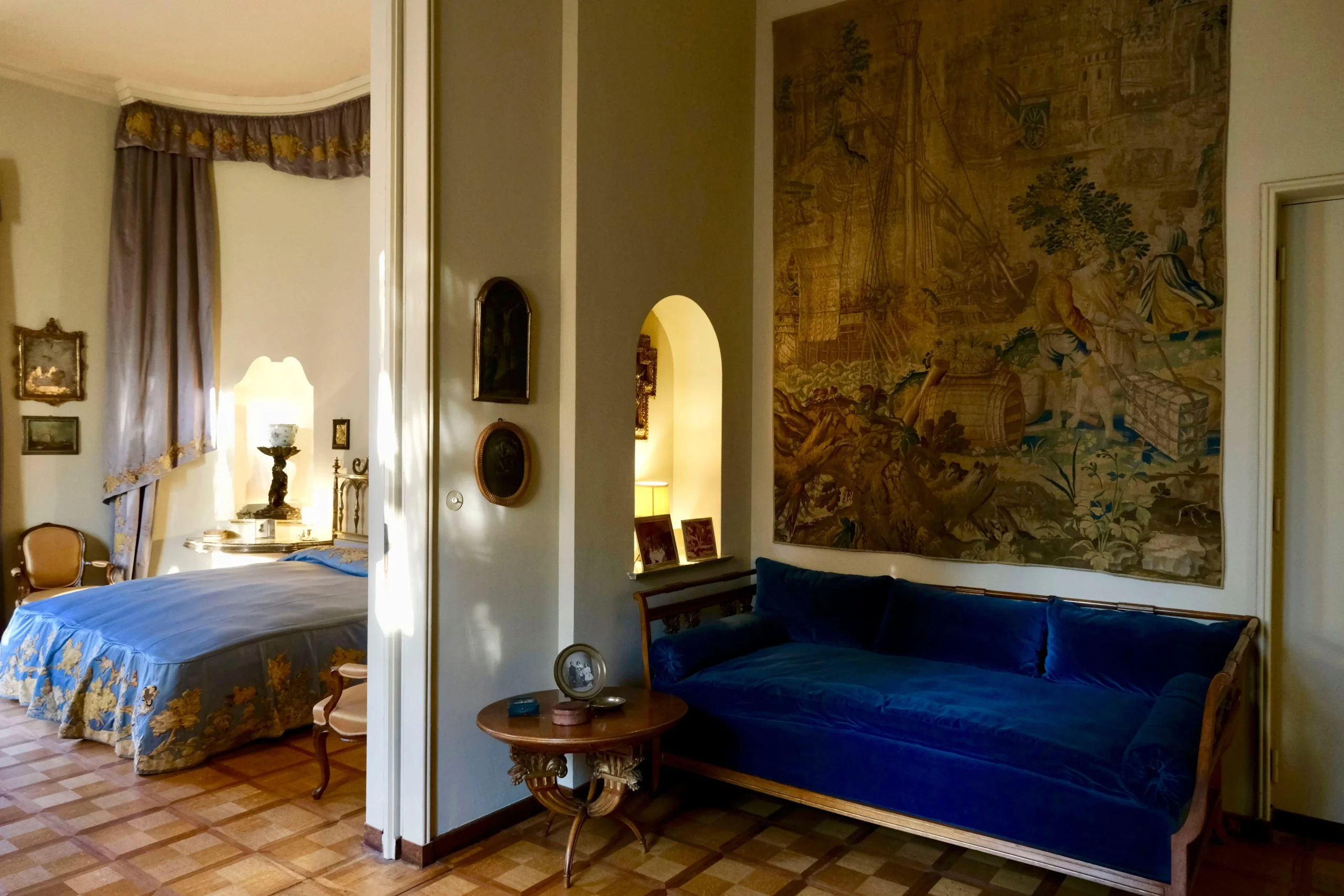
Instead, you get the strange sensation that the inhabitants have temporarily gone out. Their furniture is here. Their objects are here. The rooms still make sense as rooms.
You can imagine conversations taking place in the salon, someone reading in the library, drinks being poured, dinner arriving, guests wandering onto the veranda.
Upstairs, the atmosphere becomes more intimate. Bedrooms. Bathrooms. Dressing spaces.
Suddenly the people who commissioned this extraordinary building stop being names in an architectural history book and start becoming people who had morning routines, favourite rooms, clothes to choose and guests who stayed over.
Very glamorous guests, admittedly. But still.
Come for the architecture, stay for the voyeurism
Let’s admit something.
Part of the pleasure of visiting historic houses is architectural. Part is artistic.
And part is pure, socially acceptable nosiness.
Villa Necchi Campiglio excels at all three. You can admire Portaluppi’s architectural intelligence. You can inspect the materials and furniture. You can look at the art.
But you can also quietly wonder what it must have been like to wake up here on a Tuesday morning. Or have breakfast overlooking the garden. Or take the internal lift instead of walking upstairs like a civilian.
The house gives you a remarkably intimate glimpse of how one exceptionally privileged Milanese family lived between the wars and afterwards.
And unlike a reconstructed period interior, so much of what you’re looking at genuinely belongs to the history of the house: its architecture, furnishings and everyday objects have been extraordinarily well preserved.
That makes a difference.
Don’t forget the art
Architecture tends to steal the show at Villa Necchi — which is understandable when the architecture looks like that — but the villa also houses important art collections.
Today you’ll find works from the Claudia Gian Ferrari Collection, the Alighiero and Emilietta de’ Micheli Collection and the Guido Sforni Collection.
Together, they considerably broaden the story the house tells.
The Gian Ferrari collection brings major twentieth-century Italian art into the villa, with artists including Giorgio de Chirico, Mario Sironi and Arturo Martini.
The de’ Micheli collection takes you further back, particularly into eighteenth-century Venetian art, while the Sforni collection includes works on paper by names including Picasso, Modigliani, Matisse and Fontana.
So yes, technically you are visiting an art museum too. It’s just that the museum happens to have a swimming pool.
And in 2026, Portaluppi moved back in. Well, sort of.
There is now another very good reason to visit Villa Necchi if you’re interested in its architect. In 2026, the Piero Portaluppi Archive found a new permanent home at the villa after the collection of the former Fondazione Piero Portaluppi was transferred to FAI.
Which feels rather satisfyingly circular.
Portaluppi designed the house; now his drawings, documents, books and furniture have come to live inside it.
Three rooms in the attic have been transformed into a permanent display of furnishings and drawings from the archive, alongside a temporary exhibition programme dedicated to different aspects of Portaluppi’s work.
So Villa Necchi isn’t simply preserving one of his most famous buildings anymore. It’s also helping preserve the story of the man who created it.
Villa Necchi and the cinema: obviously
If Villa Necchi Campiglio looks cinematic, filmmakers have noticed.
Most famously, the villa provided a setting for Luca Guadagnino’s I Am Love (Io sono l’amore), starring Tilda Swinton.
Which makes perfect sense.
If you needed a building capable of playing the role of wealthy Milanese family with impeccable taste and complicated emotional lives, you would struggle to improve on Villa Necchi.
The garden deserves some lingering
Don’t make the mistake of finishing your tour and immediately marching back through the gate. Stay outside for a while.
The garden is an essential part of the experience, and seeing the villa from outside helps the architecture make sense. Walk around it. Look at how the façades change. Find Portaluppi’s sundial. Admire the garden. Stare longingly at the pool.
And if you notice the elegant pergola near the pool, there’s another small piece of the villa’s story there: the present structure was reconstructed by FAI following Portaluppi’s historic design.
Villa Necchi, like all good historic houses, isn’t simply frozen in 1935. It has been preserved, restored and carefully brought back to life.
So, is Villa Necchi Campiglio worth visiting?
Absolutely — and particularly if you’re interested in architecture, design, interiors, Milanese history or the peculiar pleasure of seeing how very rich people used to live.
It’s also an excellent choice if you’ve already ticked off Milan’s headline attractions and want to see something that reveals a quieter side of the city.
Because Villa Necchi tells a very Milanese story. Not the Milan of medieval churches. Not Leonardo’s Milan. Not even quite the Milan of grand nineteenth-century palazzi.
This is the Milan that was becoming modern: industrial, design-conscious, technologically ambitious and increasingly interested in a new kind of luxury.
Not gold everywhere. Not maximalist decoration. Good materials. Excellent design. Clever technology.
Visiting Villa Necchi Campiglio Milan: practical information
You’ll find Villa Necchi Campiglio at Via Mozart 14, in central Milan, not far from the Fashion District.
The villa is managed by FAI – Fondo per l’Ambiente Italiano. Gigina Necchi Campiglio and Nedda Necchi donated the property to FAI in 2001, ensuring that the house and its remarkable interiors could eventually be enjoyed by considerably more people than were ever invited to dinner there.
At the time of writing, Villa Necchi Campiglio is generally open Wednesday to Sunday, 10:00–18:00, although I strongly recommend checking the official FAI website before visiting for current opening times, ticket prices, special closures and exhibitions.
To sum up…
There are bigger attractions in Milan. There are more famous attractions in Milan. There are certainly attractions with longer queues in Milan.
But few places capture a particular version of the city quite as beautifully as Villa Necchi Campiglio. It’s sophisticated without being pompous, luxurious without being gaudy and historic without feeling dusty. In other words, it’s extremely Milan.
If you enjoyed this post, you might also like:
A lovely day trip from Milan: Monza’s Royal Palace
This post was all about Villa Necchi Campiglio Milan, a fabulous glimpse into the city’s glamorous 1930s past — and proof that good design, much like a heated swimming pool, never really goes out of style.